The Spanish government has designated four new mining reserves in Córdoba and Jaén. The move aims to boost Andalusia’s mining sector but faces strong opposition from environmental groups and local politicians.
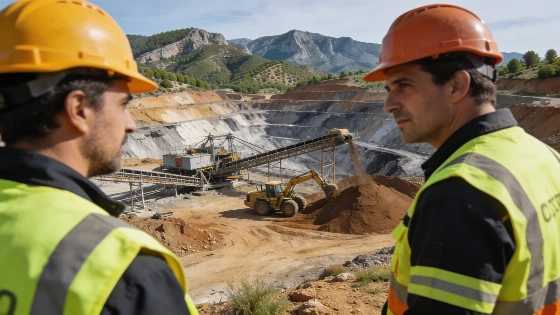
The Spanish government has officially declared four new mining reserves in the Sierra Morena region, spanning the provinces of Córdoba and Jaén. This decision, published in the Boletín Oficial del Estado, is part of the National Mining Exploration Program 2026-2030 and marks a significant push to revive Andalusia’s mining industry. The designated areas cover 22 mining grids and focus on investigating the presence of critical raw materials such as antimony, arsenic, bismuth, cobalt, copper, nickel, silver, lead, and zinc—resources considered essential for technological industries and the ongoing energy transition.
Despite Andalusia’s status as Spain’s leading mining region, with 479 active sites across 283 municipalities and a turnover exceeding €1.2 billion, the new reserves have reignited debate. Political groups and environmental organizations have voiced concerns about the environmental risks, especially in light of the planned reopening of the Aznalcóllar mine in Seville, nearly three decades after a major ecological disaster there. The Institute of Geology and Mining (IGME-CSIC) and the public company HUNOSA are set to conduct research and engineering studies over the next three years, with restoration plans to be submitted to the Ministry for Ecological Transition.
Other state-held reserves, such as Aguablanca in Badajoz and Pinoso in Alicante, are also under investigation for key minerals. Recently, the Ministry has reserved additional mining zones in Morille (Salamanca and Ávila) and San Silvestre de Guzmán (Huelva) for similar research. In parallel, the Andalusian regional government has launched the Red de Municipios Mineros de Andalucía, a network of 25 local entities aiming to maximize the benefits of mining activity. The initiative includes plans to improve specialized training, promote dual vocational education, and build a network of municipal mining experts.
Efforts are also underway to enhance the value of historical mining heritage, upgrade productive spaces, and strengthen local supplier networks. According to regional officials, Andalusia accounts for 90% of Spain’s metallic mining output, is the EU’s second-largest copper producer, and leads Europe in gypsum and Spain in marble production. The region is also the world’s top primary producer of strontium, supplying 99% of Europe’s needs and 43% globally. Its subsoil contains indications of 22 out of 34 raw materials deemed critical by the EU for energy and digital transitions.
One of the most closely watched projects is the Orion EU Critical Minerals initiative, led by Australia’s Osmond Resources, which is exploring 288 mining units in the historic Linares-La Carolina district. Here, rare earth elements are now being targeted as a potential economic driver for several northern Jaén municipalities. However, the Sociedad Ibérica para el Estudio y Conservación de los Ecosistemas (SIECE) has warned of unpredictable consequences, citing the scale of planned mineral extraction and the potential impact on traditional agriculture and private property in towns like Santisteban del Puerto, Aldeaquemada, Castellar, and Montizón. SIECE points to the company’s claims of rutile concentrations four times the global average and a projected extraction potential exceeding one billion tonnes, raising fears of a massive mining and hydrometallurgical corridor reliant on aggressive chemical processes.
These developments in Andalusia echo broader regional debates about resource management and local governance, similar to the decentralization efforts seen in other countries. For example, Colombia’s recent shift toward regional leadership, as discussed in this analysis of Colombia’s new presidential approach, highlights how local interests and environmental concerns increasingly shape national policy decisions.
Andalusia’s mining sector remains a cornerstone of the regional economy, generating around 8,000 direct jobs and representing 26% of Spain’s total mining employment. The current expansion reflects both the strategic importance of critical minerals for Europe and the persistent tension between economic development and environmental stewardship. As the government moves forward with new reserves and research, the outcome will likely influence not only local communities but also Spain’s role in the European supply chain for essential raw materials.