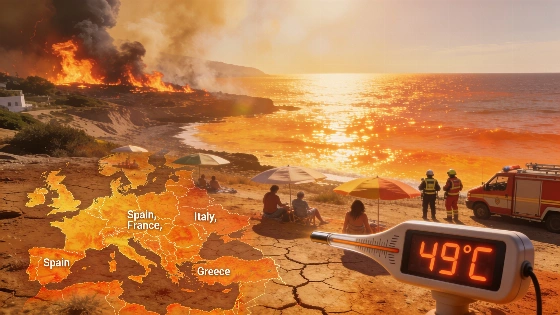
Southern Spain is bracing for temperatures near 49°C, with the Mediterranean Sea reaching 30°C. The ongoing heatwave is intensifying wildfire risks and affecting daily life across Spain, France, and neighboring countries.
Southern Spain is on alert as weather models indicate that Andalusia could approach 49°C in the coming days, a level of heat rarely seen even in this region. The Mediterranean basin is experiencing a surge in both air and sea temperatures, with the sea itself now reaching 30°C near Mallorca. This escalation is not limited to Spain: Italy, Greece, Turkey, and France are also registering extreme values, with several areas already exceeding 40°C.
Recent measurements show Andalusia surpassing 44°C, while Mallorca has recorded nearly 40°C. In Greece, Italy, and Turkey, many locations are also enduring temperatures above 40°C. Forecasts suggest the next heatwave, expected in early August, could push these figures even higher, especially in southern Spain.
The driving force behind this heat is a strong high-pressure system over central Europe, channeling hot air from North Africa into southern Europe. According to meteorologist Corinna Borau from wetter.com, European models predict highs of 42–43°C for southern Spain, but American models go further, projecting up to 49°C near Seville on August 2. Such extremes would be unprecedented for Andalusia and pose significant challenges for both residents and the environment.
France is also bracing for a new period of exceptional heat. By July 29, temperatures in Nouvelle-Aquitaine could reach 47°C, with Occitanie expecting up to 45°C. Centre-Val de Loire and Pays de la Loire may see 44°C, and even Brittany and Normandy could experience up to 42°C. These figures highlight the widespread nature of the current heatwave across western Europe.
Meanwhile, the Mediterranean Sea is warming rapidly, with surface temperatures now between 25°C and 29°C in many areas. Off Mallorca, water temperatures have hit 30°C, levels more typical of tropical regions. This unusually warm water could fuel severe storms and, under certain conditions, contribute to the formation of so-called Medicanes—Mediterranean cyclones. For comparison, the North Sea is currently much cooler, at 19–21°C.
As the heat persists, drought conditions are worsening. The risk of wildfires is rising sharply in Spain, France, Greece, and parts of Italy, where dry vegetation and strong winds create ideal conditions for rapid fire spread. The situation is reminiscent of recent emergencies, such as the mass evacuations in Madrid during a major wildfire, which was covered in detail in a previous report on the Madrid fire crisis.
Central European countries, including Germany, Austria, and Switzerland, are not immune to these developments. As hot air moves north, temperatures are rising there as well, increasing wildfire risks, particularly in southern and western Germany where drought is already present.
Heatwaves of this magnitude have become more frequent in recent years, affecting not only public health but also agriculture, tourism, and infrastructure. Spanish authorities have issued repeated warnings about the dangers of extreme heat, urging residents and visitors to take precautions. The combination of record air temperatures, unusually warm seas, and heightened wildfire risk underscores the urgent need for preparedness across the region.