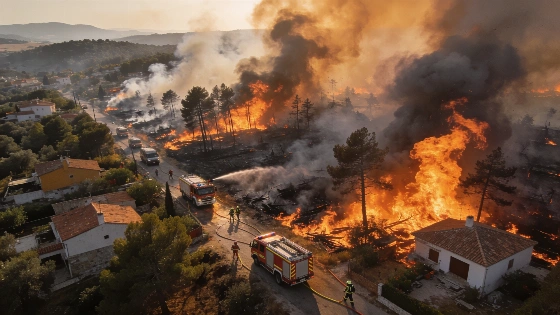
A massive wildfire in southwest Madrid has merged from three separate blazes. Extreme heat, low humidity, and strong winds have made containment impossible. Over 45,000 people are affected, with entire towns evacuated.
Southwest Madrid is facing its most severe wildfire emergency in recent memory, as three separate fires merged into a single, uncontrollable blaze late Friday. The incident has triggered the evacuation and confinement of tens of thousands of residents across multiple municipalities, with authorities warning that the fire now exceeds the region’s capacity to contain it.
Firefighters and emergency services are battling what experts classify as a fifth-generation wildfire—an event defined by the so-called 30-30-30 rule: temperatures above 30°C, humidity below 30%, and wind speeds over 30 km/h. On Friday, these conditions converged, with sustained winds from the west-southwest reaching up to 60 km/h, creating a scenario described by local meteorological officials as the most adverse possible for firefighting operations.
Madrid’s regional president, Isabel Díaz Ayuso, has called the situation the worst fire in the region’s history. The burned area has expanded from 600 to 6,000 hectares in a matter of hours, and the number of people affected has soared from 10,000 to 45,000. Entire towns—including Chapinería, Navas del Rey, Colmenar del Arroyo, Fresnedillas de la Oliva, Robledo de Chavela, Aldea del Fresno, Navalagamella, and Zarzalejo—have been evacuated, while others remain under strict confinement orders.
Despite the deployment of significant resources, emergency teams report that the fire’s intensity and speed make direct intervention impossible in many areas. According to representatives from the region’s main firefighters’ union, the current conditions mean that even well-equipped crews cannot safely approach the fire front. The blaze is now advancing through both forested and urban interface zones, threatening entire municipalities and destroying dozens of homes. In El Encinar del Alberche alone, 43 houses have been lost and nearly 300 more damaged.
Authorities have shifted their focus to protecting lives, with the main objective now to prevent fatalities. Firefighters have been instructed to allow the forest to burn where necessary, prioritizing the safety of residents and emergency personnel. The situation is so critical that many staff have voluntarily canceled their holidays to reinforce exhausted teams on the ground.
Experts attribute the disaster to a combination of factors: insufficient maintenance and cleaning of forested areas, abundant winter rainfall that fueled vegetation growth, and a series of heatwaves that dried out the landscape. The lack of forest management has left access routes impassable and provided ample fuel for the flames. As a result, even rapid response teams find themselves unable to contain new outbreaks before they escalate.
Looking ahead, meteorologists predict a slight improvement in conditions, with cooler, more humid air expected to arrive and temperatures dropping to around 29°C. However, strong winds from the north-northwest are likely to persist, and the risk of the fire spreading into neighboring Ávila province remains high. If the fires in Madrid and Ávila merge, officials warn that the devastation could extend across much of the region.
The scale of the crisis has prompted comparisons to other recent emergencies in Spain, such as the judicial reversal of a freeze on school investment projects in Valencia, which also required rapid government intervention and affected thousands of residents. For more on how regional authorities are responding to large-scale crises, see this report on the unblocking of education funding in Valencia.
Specialists stress that long-term solutions require sustained investment in forest management and prevention, not just emergency response. Calls for a national pact on climate change and wildfire prevention have grown louder, with professionals urging that resources be directed toward maintaining and cleaning forests, supporting firefighting teams, and ensuring that lessons from each summer’s disasters are not forgotten once the immediate danger passes.
Spain’s vulnerability to extreme wildfires has increased in recent years due to climate change, land abandonment, and changing weather patterns. The current emergency in Madrid highlights the urgent need for coordinated action at both regional and national levels to address the growing threat posed by these catastrophic events.