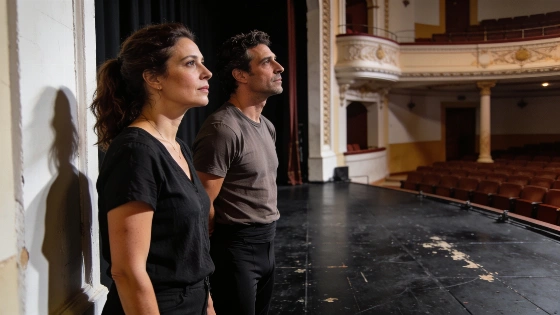
Amalia Fernández and Marco Flores have won Spain's 2026 National Dance Awards. Each receives €30,000, with Fernández recognised for creation and Flores for interpretation.
The Ministry of Culture announced the results on Wednesday, 30 September 2026. Amalia Fernández and Marco Flores each receive €30,000 for work made public or performed during 2025.
Fernández won in the creation category. Flores was recognised for interpretation. Both artists come from Andalusia, and both have built long careers as creators, performers and mentors.
Spain announced the 2026 National Dance Award results on Wednesday, 30 September 2026, naming Amalia Fernández and Marco Flores as the two laureates.
The awards can recognise a specific work or an established professional career. That rule matters here. The ministry's announcement, also reported by ABC and El Cultural, confirms the result across official and independent coverage.
Fernández was recognised for Familia. The jury praised the work's singular character and her ability to reshape choreographic composition. It also noted her search for new stage languages, the delicacy of her expression and her precise sense of the link between body, space and musicality.
The award covers more than one production. The jury also pointed to Fernández's steady support for emerging contemporary artists and her work as a teacher. She has moved between conventional stage pieces and exhibition formats. Her work gives the creation category a broad reach that includes performance and artistic research.
Fernández was born in Granada in 1970. She trained in Classical and Contemporary Dance at the Real Conservatory of Seville and at the Escuela de Teatro de la Danza de Madrid.
She later worked with Francesc Bravo, Debra Greenfield, Carl Paris, Ana Buitrago, Elena Córdoba, María Ribot and Mónica Valenciano. From 1994 to 2005, she was part of El Bailadero-Mónica Valenciano.
ABC and El Cultural independently identify both laureates as artists from Andalusia and report the 2026 decision announced on 30 September. Their coverage also matches the official breakdown: Fernández is recognised for creation, while Flores receives the interpretation award.
Her independent productions include Matrioshka, Maya, Shichimi Togarashi, Las Perras, Kratimosha, Souvenir, En Construcción versión 1, En Construcción versión 2, Perrita China and Expografía.
Fernández has also worked with Gary Stevens, Odd Enginears, Karin Elmore, Cuqui Jerez and Sonia Gómez as an interpreter, coach, choreographer and occasional collaborator. She teaches on the Master's in Performing Arts Practice and Visual Culture at UCM and works with the LOVA project.
Marco Flores receives the interpretation award for his work in Tierra virgen (2025) and the tour of Rayuela. The jury praised his technique, command of compás and virtuosity. It said those qualities help him renew flamenco through elegance and stage versatility.
Flores has followed an independent artistic path. He is described as a mature bailaor with a clear voice of his own. His work continues to explore complex socially committed subjects and support younger creators.
Flores was born in Arcos de la Frontera in Cádiz in 1981. He began as a self-taught dancer, then trained with Antonio Canales and Javier Latorre. He later joined companies led by Sara Baras and Rafaela Carrasco.
Since 2004, he has co-directed and co-produced several works. These include Dos en Compañía with Manuel Liñán, En sus 13 and En clave with Manuel and Orlga Pericet, plus Chanta la mui, Complot and Recital with Olga and Daniel Doña.
Flores created his own company in 2010. It presented DeFlamencas, which received the Special Critics' Award at the Festival de Jerez in 2012. Later productions included Tránsito, Laberínticas, Paso a Dos, Entrar al Juego, Fase Alterna and Extracto Abierto. His first solo was Extrema.
His previous distinctions include Radio Nacional de España's El Ojo Crítico de Danza in 2019, along with the Carmen Amaya, Antonio Gades and Mario Maya awards. He also received the Special Baile Award at the Concurso Nacional de Arte Flamenco de Córdoba in 2007.
Spain's national cultural calendar also includes the 2027 Goya ceremony in Navarra, as reported earlier.
Dance has its own message. The Ministry has rewarded new choreographic languages and the force of an individual performer.
That is the wider result.
Fernández represents experimentation shaped by teaching and collaboration. Flores joins flamenco technique with authorship and social inquiry. Each winner receives €30,000, and the jury also stressed the value of artistic continuity.
The 2026 awards put two ideas beside each other. Spanish dance can invent new forms. It can also strengthen the wider creative community.