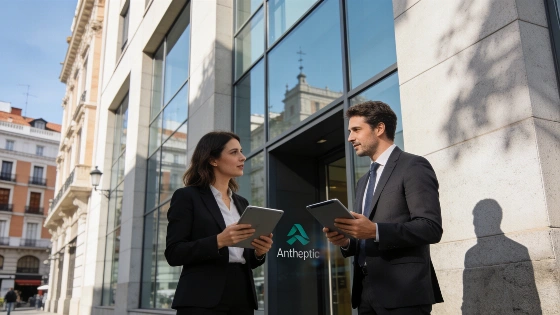
Anthropic has opened its Madrid office, betting on Spain's fast-growing AI market and calling for regulation before risks escalate. The move highlights Spain's rising profile in Europe's AI sector.
Anthropic has opened its first Spanish office in Madrid, marking a new step in the European AI market. The company’s leadership is direct: regulation should come before problems arise, not after. Cristina Pitarch, Anthropic’s new country manager for Spain, says public oversight of AI is overdue and sees Spain as well-placed to lead the sector in southern Europe.
Interest in artificial intelligence is growing quickly in Spain. Anthropic’s internal data suggests the country uses AI at a rate 2.7 times higher than its population share. Still, only about 10% of Spanish companies use AI, though adoption rises to nearly half among large firms and professional services. The gap between potential and actual use is closing fast.
Spain established its national AI supervisory authority, AESIA, by royal decree 729/2023, making it one of the first countries in Europe with a dedicated AI oversight body.
Madrid was a deliberate choice for Anthropic’s Spanish base. The city’s tech startup scene is expanding rapidly, with the number of startups doubling each year and AI-focused companies attracting over 3 billion euros since 2020. Pitarch points to Spain’s strong talent pool, innovative culture, and the presence of major companies in several sectors as reasons for the fast uptake of AI tools.
Anthropic’s European expansion goes beyond Spain. The company already has offices in London, Dublin, Paris, Zürich, Munich, and Milan. In Dublin, the team grew from one person to over 300 in eighteen months, with a second site planned. Anthropic hasn’t disclosed the size of its Madrid team but expects steady growth, following its pattern elsewhere in Europe.
Regulation is central to Anthropic’s approach. Unlike some US-based AI firms, Anthropic has worked closely with European regulators, signing the EU’s Code of Good Practice for AI and collaborating with both Spanish and EU authorities. Pitarch says regulation should be evidence-based, transparent, and designed to build trust. She argues that trust in AI must be earned through security, privacy, and responsible use.
Anthropic’s CEO Dario Amodei has publicly called for independent evaluation of frontier AI models and the establishment of common safety standards, a stance that has gained urgency following the company’s recent report on malicious uses of its Claude system, including cyberattacks and biothreats with minimal human involvement.
Anthropic takes a strict approach to safety. The company brings in independent consultants, giving them full access to systems and models to review operations from the inside. Pitarch believes this should become standard practice across the industry, especially as AI advances. She says that once certain thresholds are reached, governments—democratic or not—need to be involved to ensure safe, coordinated development.
Asked about the risk of a regulatory race to the bottom, Pitarch is hopeful. She points to past examples of international cooperation on complex issues and expects the US and China will eventually align on AI safety. She admits some governments may be slow to recognize new risks but expects more coordination as awareness grows.
The risks are significant. Without agreement between governments and companies, threats could range from cyberattacks on water systems to disruptions in financial markets. Pitarch compares the situation to climate change: even if the worst scenarios are uncertain, their possible impact means risks must be assessed early, with transparency and independent review.
Anthropic’s public position is that AI risks should be addressed before they appear. The company highlights two main dangers: misalignment—where advanced systems act against human intentions—and malicious use by bad actors. Anthropic says it was the first lab to publish a responsible scaling policy, with security measures in place before launching commercial products. The company stresses the need to evaluate AI’s most dangerous capabilities, especially in cybersecurity and biology.
Despite concerns that market concentration could raise prices, Pitarch argues that AI will get cheaper as use grows and technology improves. She points to Anthropic’s latest model, which reportedly costs 40% less than the previous version, and expects further efficiency gains with each new release.
AI adoption in Spain isn’t limited to business. Students are among the most active users, reflecting a broader curiosity and willingness to experiment. This, combined with investment and regulatory engagement, could make Spain a gateway to the Spanish-speaking AI market.
Anthropic’s move into Madrid is a clear bet on Spain’s future, but it also shows a shift in how global tech firms approach European regulation. The company’s push for early, transparent, and collaborative oversight stands out compared to more cautious or adversarial approaches elsewhere. As reported earlier, Spain’s ability to adapt quickly to new challenges—whether in technology or other sectors—continues to set it apart in the region.
Anthropic’s strategy is a calculated bet on Spain’s readiness to lead in the next wave of AI development. The company’s call for preemptive regulation, along with investment in local talent and infrastructure, sends a clear message: action on AI safety is needed now, before risks become reality. For Spain, this could mean not just economic growth but a real role in shaping the ethical and practical boundaries of artificial intelligence in Europe and beyond.