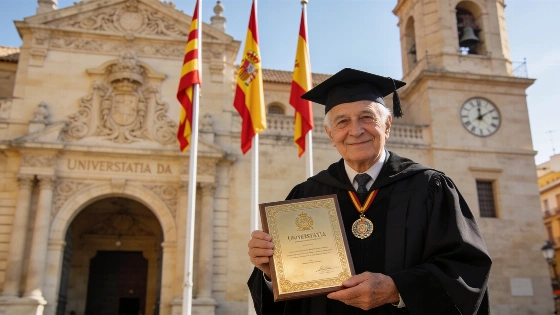
Antonio Ariño Villarroya, professor emeritus at the Universitat de València, has been awarded Spain’s top prize in sociology and political science. The recognition highlights his extensive research and academic contributions.
Antonio Ariño Villarroya, professor emeritus at the Universitat de València, has been named the recipient of the 2026 National Sociology and Political Science Award. The decision, published in the Boletín Oficial del Estado on July 3, marks a significant recognition of his decades-long academic career and his impact on social research in Spain.
The award, granted by the Centro de Investigaciones Sociológicas (CIS), is one of the country’s most prestigious honors in the field. The jury, chaired by CIS president José Félix Tezanos, reached its decision by majority during a session held on June 9, 2026. Ariño, now 73, has played a central role in shaping sociological studies at the Universitat de València, where he served as professor, department head, and later as vice-rector between 2003 and 2020, taking on various leadership responsibilities.
Born in Allepuz (Teruel), Ariño’s academic journey has been closely tied to Valencia. He holds a degree in Geography and History (1985) and earned his doctorate in Sociology in 1990 with a thesis on contemporary Valencian society. His research has focused on cultural sociology, social welfare policies, and the Third Sector, and more recently, he has concentrated on disaster and catastrophe studies, collaborating with multiple research groups.
The CIS award aims to promote applied social research and is governed by the institution’s regulations. Notably, this is the second consecutive year the prize has gone to a faculty member from the Universitat de València, following last year’s recognition of Capitolina Díaz Martínez. The official award ceremony date will be announced soon.
The jury for this year’s award included José Félix Tezanos Tortajada, Silvia García Ramos, Rosario H. Sánchez Morales, Constanza Tobío Soler, Rafael Pardo Avellaneda, Luisa Carlota Solé i Puig, Almudena Moreno Mínguez, Javier de Estaban Curiel, Antonio Francisco Alaminos Chica, and Capitolina Díaz Martínez, with María Asunción Garzón Martínez serving as secretary without voting rights.
Throughout his career, Ariño has authored numerous books and scientific articles, directed the Institute of Social and Cultural Sciences at the Institución Alfons el Magnànim, and served as vice president of the Spanish Federation of Sociology. Among his most notable distinctions is the 1992 National Research Award for his work "La ciudad ritual," which solidified his reputation in academic circles. He was also named Chevalier de l’Ordre des Palmes Académiques by the French government in 2014 for his contributions to academic and cultural cooperation, and received the 2017 Valencian Literary Criticism Award in the Essay and Criticism category, together with Joan Romero, for the book "La secesión de los ricos." Ariño has also led the Observatory of Participation and Living Conditions of University Students (ECoViPEU).
Recognition of academic achievement in Spain often reflects broader trends in the country’s approach to social sciences and higher education. The National Sociology and Political Science Award, established to encourage excellence in applied research, has become a benchmark for scholarly impact. The Universitat de València, one of Spain’s oldest and most respected universities, has seen a notable presence among recent awardees, underlining its influence in the field. For context, the importance of long-term public service and academic leadership in Spain was also highlighted recently when the mayor of Chercos, José Antonio Torres Sáez, was remembered for his decades of dedication. Such recognitions underscore the value placed on sustained commitment and innovation in Spanish public life.