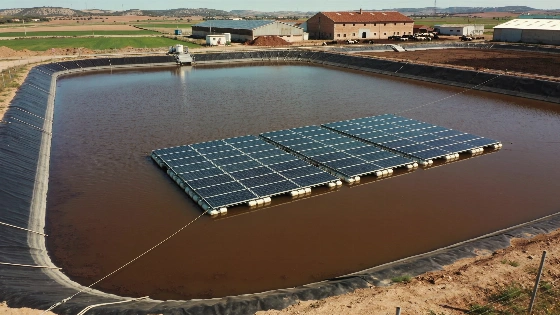
A livestock farm in Tauste, Zaragoza, has installed floating solar panels on its manure lagoon, targeting a 53% reduction in electricity use and lower gas emissions. The project uses existing space to generate renewable energy without taking up extra land.
On the outskirts of Tauste, Zaragoza, a livestock farm has taken an unconventional step to address two persistent challenges: high energy costs and harmful gas emissions. By installing a floating solar platform on its manure lagoon, the farm is now generating its own electricity while reducing the environmental impact of waste storage.
The prototype, developed by Fotopur, consists of 16 solar panels mounted on a modular plastic platform that floats atop a 1,100-square-meter lagoon. This setup covers about 10% of the lagoon’s surface, with the panels supported by an aluminum structure designed to withstand the corrosive ammonia-rich environment. The system is expected to produce 15.2 MWh of electricity annually, potentially meeting up to 53% of the farm’s energy needs—a significant shift for an operation previously reliant on diesel generators and a small solar array for basic automation.
Open manure lagoons are a common feature of pig farms in Spain, but they come with environmental costs. When exposed to air, these lagoons release ammonia, methane, and other gases. Covering even a portion of the surface with solar panels not only puts unused space to work but also helps trap emissions before they escape into the atmosphere. This dual benefit is especially valuable for farms with limited land, as it avoids the need to dedicate additional fields to solar installations.
Technical Challenges
Building a solar array over a manure lagoon is not as straightforward as installing panels on a roof or field. The corrosive gases can quickly degrade standard materials, so Fotopur’s design uses components chosen for durability in harsh conditions. The floating platform also adapts to changes in lagoon water levels, ensuring the panels remain stable and functional throughout the year.
While the Tauste prototype covers only a fraction of the lagoon, a second trial in Zamora is testing a larger system: 56 panels with a peak output of 33.04 kWp, expected to generate 50.04 MWh annually. In this case, the coverage can exceed 90% of the lagoon’s surface when plastic elements fill the gaps between panels. Early estimates suggest this could cut ammonia emissions by up to 90%, though these figures await confirmation from ongoing measurements.
Reducing Emissions and Diesel Dependence
For the Tauste farm, the new solar platform is more than an environmental gesture. Isolated from the main power grid, the farm previously depended on diesel generators for most of its electricity. The floating solar system is projected to cover more than half of its annual demand, reducing both fuel costs and the farm’s carbon footprint. However, Fotopur notes that actual savings will depend on the farm’s specific conditions and the system’s real-world performance over time.
Beyond energy savings, the project highlights the potential for existing agricultural infrastructure to serve new purposes. By transforming a waste lagoon into a renewable energy source, farms can address environmental regulations and rising energy prices without expanding their physical footprint.
Scaling Up and Next Steps
Whether this approach can be widely adopted will depend on how well the systems withstand corrosion, how easy they are to maintain, and whether they interfere with daily farm operations. The modular design allows for adjustments as lagoon levels change, but long-term durability remains under review. Results from the Tauste and Zamora prototypes will help determine if floating solar platforms can become a standard feature on Spanish farms.
Innovative solutions for livestock operations are not limited to Spain. In a related example, Japanese researchers found that painting cows with zebra-like stripes could halve fly attacks, offering another creative approach to animal welfare and farm management. (Japanese study on livestock protection)
As energy prices and environmental standards continue to evolve, projects like the one in Tauste may point the way toward more sustainable and efficient farming practices across Europe.