In a bold field test, Japanese researchers painted six black cows with zebra-like stripes and saw fly landings drop by nearly 50%. The study suggests a simple visual trick could offer farmers a new way to shield cattle from biting insects without chemicals.
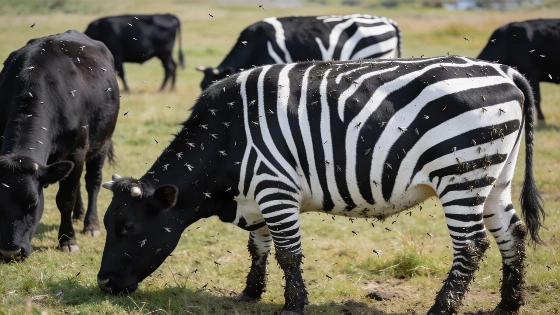
Six black Japanese cows, each grazing quietly in a pasture, became the focus of an unusual scientific experiment: researchers painted them with white stripes, mimicking the iconic pattern of a zebra. The result was immediate and striking—these striped cows attracted almost half as many biting flies as their unpainted counterparts.
The study, conducted in Japan, set out to test a long-standing theory: that the black-and-white stripes of zebras serve as a natural defense against insects. To isolate the effect of the stripes themselves, scientists rotated each cow through three conditions—painted with black-and-white stripes, painted with black stripes only, and left unpainted. This careful design ruled out the possibility that the paint's smell or texture alone was responsible for any change.
How the Experiment Worked
Each cow spent time in all three scenarios, allowing researchers to compare the number of flies landing on their bodies and legs. The white stripes, painted with water-based, animal-safe paint, measured about four to five centimeters wide. After each observation period, the team used photographs to count the insects resting on the cows.
The results were clear: cows with zebra-like stripes had nearly 50% fewer fly landings than those with only black stripes or no paint at all. The cows painted with just black stripes showed no significant difference from the unpainted group, confirming that the visual contrast—not the paint itself—was key.
Why Stripes Work
Researchers also tracked how often the cows tried to shake off the flies by swishing their tails, stamping their legs, or tossing their heads. The striped cows performed these defensive movements far less frequently, suggesting they were genuinely less bothered by insects.
While the exact mechanism remains under study, the leading explanation is that the alternating light and dark bands disrupt the flies' ability to judge distance and speed as they attempt to land. This confusion appears to make it harder for the insects to complete their final approach, reducing successful landings.
Similar effects have been observed in previous experiments with zebras, horses, and even striped blankets. The evidence increasingly points to a visual barrier, rather than a chemical repellent, as the main factor behind the stripes' protective power.
Beyond the Zebra: Implications for Farming
Biting flies are more than a nuisance for cattle—they can cause stress, reduce feeding time, and even lead to injuries as animals cluster together to escape the pests. Farmers often rely on insecticides, but these chemicals can be costly, require frequent application, and raise environmental concerns.
The Japanese study, as reported by Talent24h, suggests that painting livestock with stripes could offer a practical, non-chemical alternative. However, the method is not without challenges. The paint used in the experiment faded within days, while fly season can last for months. For large herds, a more durable and efficient solution would be needed before the approach could be widely adopted.
Although the experiment involved only six cows, it adds valuable field evidence to the growing body of research on how visual patterns can protect animals from insects. The findings open the door to new strategies for livestock management, especially as farmers seek to reduce reliance on pesticides.
For now, the sight of a striped cow may be rare, but the science behind it is gaining ground—and could one day change how farmers around the world protect their herds.