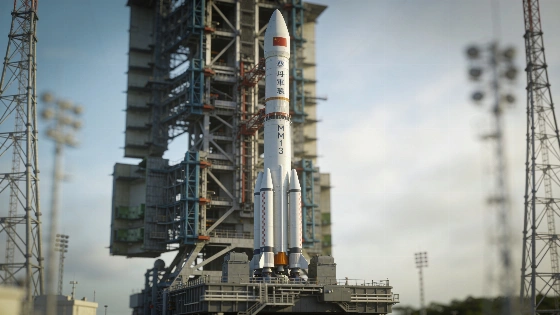
Japan’s MMX spacecraft is scheduled to launch on 19 October at 21:41 Spanish peninsular time. JAXA plans to collect Fobos material and return it to Earth.
Each of MMX’s two planned touchdowns on Fobos will last only two or three hours. The moon’s weak gravity leaves little room for error: the spacecraft could strike the surface or bounce back into space. JAXA plans to collect at least 10 grams of regolith.
Weak gravity makes each landing a brief, high-stakes operation.
The spacecraft is scheduled to launch on 19 October at 21:41 Spanish peninsular time, or 20 October at 04:41 in Japan. An H3 rocket will carry it from the Yoshinobu launch complex at Tanegashima. The mission will study Fobos and bring surface material back to Earth, a return from the Martian environment that has never been attempted. According to The Planetary Society, a broader launch window could remain open through 7 November if the planned attempt is scrubbed.
To gather the material, a robotic arm will use a coring sampler to penetrate about 2.54 centimetres into the surface. A pressurised gas injector will draw the samples into the spacecraft. During one touchdown, MMX is also due to release IDEFIX, a small robot developed by German and French organisations. DLR and CNES are involved in its development. The mobile explorer is designed to work on Fobos and is expected to explore the surface for about 100 days.
Before descending, MMX is due to spend a year studying Fobos from a quasi-satellite orbit. ESA describes it as the first spacecraft planned to orbit the moon. After a year-long journey to Marte, its engines will slow it enough for the planet’s gravity to capture it in a path similar to Fobos’s orbit. NASA expects the spacecraft to arrive at Marte in August 2027. Sample collection is planned for no earlier than December 2028.
NASA is supplying two spectrometers for the mission. France’s CNES built another instrument. A dust sensor will look for particles that may have been knocked loose from Marte or Fobos by meteorite impacts.
MMX will map Fobos in 3D and select a sampling site. Its cameras will send high-resolution images and video from Marte, including views of both moons. The spacecraft is also expected to make close observations of Deimos during its trajectory. JAXA is leading the mission, with NASA and CNES involved. DLR and ESA are also partners.
The samples could help test two explanations for the moons’ origins. They may be asteroids captured by Marte’s gravity. Alternatively, they may have formed in orbit after a large body struck the planet. Fobos measures 22.2 kilometres across; Deimos measures 12.5 kilometres. Both are irregular and follow unstable orbits. Scientists believe Fobos may move close enough to Marte to be torn apart by the planet’s gravity within tens of millions of years. NASA says laboratory analysis will let researchers compare Fobos’ mineralogy and organic components with those of Marte. The samples will also be compared with material from asteroids.
JAXA expects to begin the descent sequence between late 2028 and early 2029. MMX must carry out the manoeuvres autonomously because signals between the spacecraft and Earth can take up to 44 minutes to make the round trip.
The mission is planned to leave Martian orbit around 2030. After a year-long return journey, MMX will release a capsule containing the samples, with arrival on Earth planned for 2031. The capsule is due to enter Earth’s atmosphere and land by parachute in Australia. ESA says it is designed to return at least 10 grams of Fobos material. NASA plans to receive and curate about 15% of the sample at the Johnson Space Center Astromaterials Lab in Houston, where it will be available for research for decades.
Japan’s earlier asteroid missions provide the technical groundwork. Hayabusa returned microscopic particles from Itokawa in 2010 despite suffering multiple failures. Hayabusa2 collected material from Ryugu in 2019 and brought back 5.4 grams in 2020. The heat shield and parachute system on its re-entry capsule are direct predecessors of the technology planned for MMX.