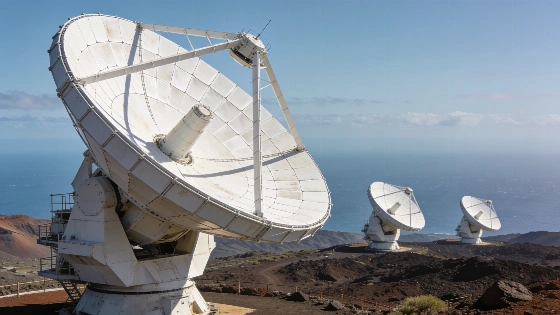
Four giant telescopes will be inaugurated in La Palma on 15 October 2026. Construction is ending, but commissioning and formal acceptance will decide when they begin scientific operations.
At the Observatorio del Roque de los Muchachos, LST-1 has been undergoing tests since its inauguration in 2018.
La Palma will host the inauguration of four large-sized telescopes on 15 October 2026. The ceremony will complete construction of all large-sized telescopes planned for CTAO-North and move the Cherenkov Telescope Array Observatory closer to its first scientific operations. Three additional telescopes now join LST-1 at the site.
The instruments are not ready for full scientific exploitation. The LST Collaboration must complete an extensive commissioning process before each telescope can be formally accepted by CTAO ERIC, the central organisation responsible for the observatory. According to CSIC, LST-1 is expected to become the first accepted telescope during 2027. That decision would open the way to CTAO's early science programme and its wider scientific output.
In October 2026, LST-1 was used together with the MAGIC telescope to observe the distant blazar OP 313, whose gamma-ray emission travelled to Earth for about eight billion years before being detected.
The telescopes are designed to detect faint flashes produced when high-energy gamma rays collide with Earth's atmosphere. Those collisions generate particle cascades and extremely brief blue Cherenkov light. The instruments capture that light from the ground, then reconstruct events that cannot be observed directly in the same way.
Each LST has a 23-metre reflector, stands 45 metres high and weighs 100 tonnes. Despite its size, it can be repositioned in less than twenty seconds to point at any location in the sky. That speed matters for transient phenomena such as gamma-ray bursts and fast radio bursts. It also supports searches for possible gamma-ray counterparts to gravitational-wave events.
The LST design is intended to extend CTAO's sensitivity down to roughly 20 GeV. Combined with an expected sensitivity improvement of up to ten times over current-generation installations, this low-energy reach should help researchers study more distant high-energy sources and expand the observatory's gamma-ray horizon.
The project gives Spain a strong position inside CTAO. Alongside Japan, Spain is the largest contributor to the LST programme, with a 32% share. Hosting CTAO-North at the Observatorio del Roque de los Muchachos in La Palma also guarantees the Spanish scientific community 10% of observing time. Researchers will have direct access to an instrument intended to operate as an open observatory rather than a facility reserved for a single closed collaboration.
Spanish participation covers research and engineering. The ICCUB contributed to CTAO's development and to the conception of the four LSTs. Josep Maria Paredes and Marc Ribó followed the project from its early design through technology development. David Gascón and Pol Bordas worked on the project through its scientific planning. Spanish companies also manufactured key components, including movement systems and camera mechanics. Infrastructure was another part of that work.
Gascón's team at the ICCUB and IEEC worked on camera components and developed three integrated circuits for measuring photon signals at high speed. Spanish institutions also helped create the data-filtering system. It analyses millions of images per second in real time, removing background signals such as ambient light and other stars while isolating patterns associated with gamma rays within fractions of a nanosecond.
The Spanish network includes institutions in Andalusia and the Canary Islands. Catalonia and Madrid are also represented. Its members include ICCUB, IEEC, CIEMAT and IAA-CSIC. The network also includes IAC, ICE-CSIC, IFAE, UAH, UCM and UJA. The project sits within a wider public-interest agenda that ranges from housing disputes to national science infrastructure. CTAO's practical value lies in the observing capacity it places within reach of researchers.
CTAO will combine LST, medium-sized and small-sized telescopes across La Palma and the desert of Atacama in Chile. La Palma is therefore only the northern part of the planned observatory. The complete infrastructure is expected to include more than sixty instruments across CTAO-North and CTAO-South. Together, they will cover energies from 20 GeV to 300 TeV.
The observatory is expected to generate hundreds of petabytes of data annually, approximately 12 PB after compression. It will provide public access to high-level scientific data and software products.
Its scientific agenda includes cosmic relativistic particles and extreme environments around black holes and neutron stars. Researchers will also study dark matter and possible departures from Einstein's theory of relativity. A published CTAO scientific study describes the facility as the next generation of ground-based Cherenkov telescopes, with a projected sensitivity improvement of up to an order of magnitude over current instruments.
The OP 313 observations provide an early practical demonstration of LST-1's capability. They show that the telescope can contribute to research on extremely distant high-energy objects while it remains in commissioning. The full northern configuration has not yet completed formal acceptance.