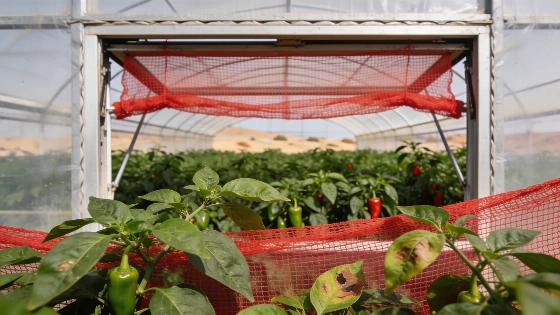
At the Las Palmerillas Experimental Station, red insect netting held back the arrival of Thrips parvispinus. But populations grew rapidly after the pest entered the greenhouses. Fundación Grupo Cajamar’s preliminary results, reported on Plataforma Tierra, found that low-pressure misting did not stop the growth either.
The findings matter because the trial tested a measure growers in Almería are already adopting. The pest was detected in pepper crops there in 2020, after arriving in Spain on imported ornamental plants in 2017. During the 2024/25 season, it was present in 40-50% of greenhouses in the Poniente area, according to the source material. It can damage shoots and leaves, as well as flowers and fruit. Population peaks occur in October and November.
The scale of the problem grew further. By late October 2026, reporting said T. parvispinus was present to some degree across all of Almería’s more than 12,700 hectares of pepper production. Ideal reported almost 300 sanctions for failures to comply with sector measures, including crop removal when required. On 13 October, Coexphal’s board unanimously approved an urgent package of measures and sent its demands to the Andalusian agriculture authorities.
Researchers compared three identical 630 m² multi-tunnel greenhouses with matching structures and ventilation. The first had red mesh rated at 20 × 10 threads per cm². Researchers used white mesh of the same specification as a control in a second house. The third had white mesh and low-pressure misting, to test whether higher humidity helped beneficial predators establish.
All three houses grew California pepper variety ‘Saitama’, transplanted on 7 August, and received the same biological-control releases. Amblyseius swirskii was introduced on 10 September, followed by Orius laevigatus on 21 September. Franklinothrips megalops was released on 25 September, and lacewing larvae were added on 5 October.
The researchers’ conclusion is limited but clear: red mesh delayed entry during the first weeks, yet did not control the pest once it was inside. The population then rose exponentially, as it did under the other mesh conditions, and caused severe crop damage. Misting improved the greenhouse climate but did not halt the increase. Reporting on the trial published on 30 October 2026 also described red mesh as postponing entry, not preventing the pest from eventually establishing and increasing rapidly.
A 2024 study in Scientific Reports offers some background for testing red netting. In laboratory tests, Thrips tabaci crossed red mesh less often than white mesh. In field-grown spring onions, red mesh reduced adult and larval numbers. The researchers suggested that greater reflection of light above 600 nm could affect thrips’ vision, while stressing that the mechanism had not been confirmed. Those results involved a different thrips species and crop.
The trial report also described uneven establishment of beneficial insects. Predatory mites settled relatively well but lagged behind the pest, while few Orius were found in flowers despite several weeks of releases. One proposed explanation was the abundance of ants in flowers. At a technical meeting, Julián Giner of Koppert offered another possibility: thrips may compete with Orius for pollen, limiting food for the predator’s nymphs. Neither explanation has been confirmed; both need further investigation.
IBMA España has called for a coordinated, year-round biological-control strategy and urged consistent adherence to the Junta de Andalucía’s protocol across the sector, including growers and cooperatives as well as companies and agronomists. The association has also emphasized removing heavily affected crops to limit pest pressure on neighboring holdings. In late October 2026, the Mesa de Sanidad Vegetal sought temporary authorization for spirotetramat against the pest, but Spain’s Ministry of Agriculture rejected the request. Growers remain reliant on biological and cultural measures. Sector reporting said pepper exports remained guaranteed and that the pest does not affect food safety or taste.
Fundación Grupo Cajamar is also comparing Amblyseius swirskii with two alternatives: Amblyseius montdorensis and Amblyseius limonicus. Separate trials compare red greenhouse whitening with standard whitening. They also assess a light-transmitting photoselective coating, which is intended to let more useful light reach the crop, not to target the pest. Other tests are assessing refuge plants that could sustain beneficial insects.
The research focuses on Almería’s agricultural sector, unlike RUSSPAIN.COM’s Cáceres excavation report. The trial’s results remain preliminary. The source says further updates will follow as insect counts progress.