Fernando Alonso retired on lap 21 of the Azerbaijan Grand Prix after reporting a sharp loss of straight-line speed. Honda says its data showed no engine fault and will review the car, power output and energy management.
On lap 21, Fernando Alonso brought his Aston Martin into the pits after repeated radio complaints about a loss of speed on the straights. It was his sixth retirement of the 2026 season. Honda said its data showed no engine fault, leaving a gap between Alonso's cockpit report and the manufacturer's first diagnosis.
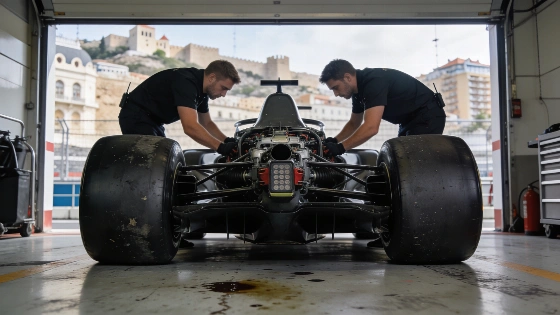
The trouble had started before the race. Aston Martin fitted a new power unit before Alonso reached the track, then found an oil leak on the first day. Honda had already seen unusual lubrication-system data during FP2. Some components were changed overnight, and the team reversed part of the original switch by fitting parts from the previous specification.
That brought fresh power-unit allocation and penalty risks. The team had little room to spare.
Alonso retired on lap 21 after a series of radio messages about the car’s abnormal behaviour and loss of straight-line speed.
A warning had appeared before the main event. Honda still says the new engine is suitable for the rest of the season.
During the race, Alonso could fight only with Valtteri Bottas. Sergio Pérez's Cadillac pulled away by more than one second per lap. The gap stood out on Baku's long straights.
Alonso told the team several times that the time loss against the American car was not normal. He then brought the AMR26 into the pits.
Honda F1 chief Shintaro Orihara said the available data showed no engine abnormality. The manufacturer plans to check the maintenance work, factory information, engine power, energy management and GPS data. That review has not settled the cause of Alonso's decision. Motorsport.com reported that Alonso chose to stop after the radio exchanges.
Independent reports describe the retirement as Alonso’s own decision after several radio messages to the team, rather than a confirmed engine shutdown ordered by Honda.
A wider Aston Martin problem also showed up over the weekend. In qualifying, vibrations caused Alonso to lock his tyres in the second sector. His attempt had been close to both Audi cars, despite their practically new car package in Baku.
The result points to a stronger Aston Martin chassis since Hungary. The power unit introduced at the Dutch Grand Prix remains a separate concern.
Top speed made the problem harder to miss. Formula 2 cars reached a higher speed in Baku than the AMR26. The Honda engine had also looked vulnerable in Monza.
That comparison does not prove what caused Alonso's retirement. It does explain why Cadillac's advantage looked so large.
Honda said the irregular oil-system signals appeared during FP2. It identified the cause and replaced the affected parts. No further engine issue appeared in FP3, qualifying or the race, according to the manufacturer.
Honda therefore considers the new unit ready to stay in service until the end of 2026. RacingNews365 reported that the lubrication-system problem emerged before the race weekend had fully developed. The reliability concern came first.
The confirmed facts still show an operational problem. Aston Martin changed power-unit components before the race. Alonso reported behaviour he considered abnormal. The car lacked straight-line speed against Cadillac and even Formula 2 machinery.
Honda's data currently supports the engine. The retirement shows that the car as a whole was not delivering an acceptable result. Power and energy-management checks must explain the lost pace before Honda's confidence can settle the issue. From the cockpit, the performance no longer made sense.