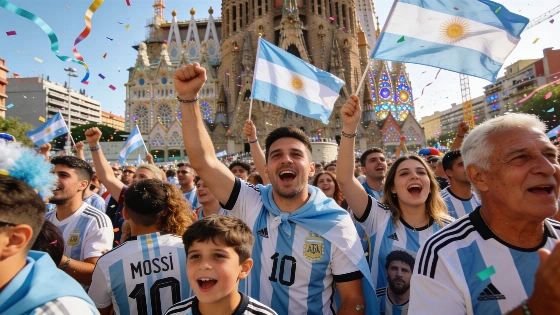
Barcelona now hosts over 50,000 Argentines, making them the largest foreign-born group in the city. As the World Cup final approaches, the community’s presence is felt in local businesses and public celebrations.
Barcelona is witnessing a striking demographic shift as the number of Argentine residents climbs to unprecedented levels, now nearing 50,000 according to city data. This surge has transformed the Catalan capital, with Argentine-run bakeries, restaurants, and cultural spaces becoming increasingly visible across neighborhoods. The timing is notable: as Argentina prepares to face Spain in the World Cup final, the city’s Argentine community is organizing large gatherings to watch the match, highlighting both their growing influence and the unique tension of supporting their home country while living abroad.
For many, football is the thread that binds the community. Diego La Loggia, a 42-year-old physical trainer from Buenos Aires, moved to Barcelona seven years ago, drawn by the city’s football culture and the legacy of Lionel Messi. After experiencing Argentina’s dramatic World Cup victory in Qatar in 2022, La Loggia is now preparing to watch the final in Barcelona, a city he now calls home. He notes the rapid growth of the Argentine presence, recalling how public spaces like the park at Glòries have become spontaneous gathering points for celebrations and traditional activities such as sharing mate on Sunday evenings.
The demographic shift is not limited to numbers. Many Argentines arrive with dual citizenship, often Italian or Spanish, complicating official statistics. While only about 12,900 Argentines are registered with Latin American passports, the real figure is much higher due to dual nationality. This trend mirrors the broader rise in Italian registrations in Barcelona since 2013, much of which is attributed to Argentines with Italian heritage. The city’s appeal lies in its beaches, perceived safety, and stability, factors that have made it a preferred destination over traditional hubs like Miami.
Integration remains a challenge for newcomers. La Loggia, despite holding an Italian passport, faced hurdles in validating his professional qualifications and securing the necessary UEFA licenses, as his South American credentials were not recognized in Europe. To ease the transition for others, Celina Achiary founded La Filial, a network connecting new arrivals with Argentine businesses, legal advisors, and cultural activities. The initiative aims to provide practical support and a sense of belonging, while also encouraging integration through partnerships with local institutions, such as offering Catalan language courses.
Long-term residents like Andrea Cardinali, who arrived during Argentina’s 2001 economic crisis, have witnessed the transformation firsthand. After regularizing her status and embracing local culture—including learning Catalan and working on city projects—she observes that Argentine symbols, from football jerseys to empanada shops, are now a common sight. The emotional complexity of supporting both Argentina and Spain in the final is shared by many, especially as local Catalans often rally behind Argentina due to the enduring connection with Messi.
As the final approaches, Argentine WhatsApp groups in Barcelona are buzzing with plans to watch the match together, whether in bars, hotels, or private homes. One group with over 500 members is searching for a venue large enough to accommodate everyone, hoping to recreate the scenes from 2022, when more than 14,000 fans gathered at the Arc de Triomf to celebrate Argentina’s World Cup win. The city’s authorities are aware of the scale of these gatherings, which reflect both the passion for football and the evolving face of Barcelona’s immigrant communities.
Argentina’s growing presence in Barcelona is part of a broader trend of Latin American migration to Spain, driven by economic, social, and cultural factors. The city’s openness to newcomers, combined with established support networks, has made it a focal point for Argentines seeking stability and opportunity in Europe. This dynamic is not unique to Barcelona; similar patterns have been observed in other Spanish cities, as highlighted in reports of crowd unrest and passionate fan gatherings during major football events, such as the recent World Cup semifinal in Atlanta. As Barcelona prepares for another high-stakes final, the city’s Argentine community stands as a testament to the enduring power of sport and migration to reshape urban life.
For context, Spain has become one of the top destinations for Latin American migrants in Europe over the past decade, with Barcelona leading in the number of foreign-born residents from Argentina. The city’s integration policies, combined with its vibrant cultural scene and economic opportunities, continue to attract new arrivals. As the World Cup final draws near, the intersection of sport, migration, and local identity is more visible than ever in Barcelona’s streets and public spaces.