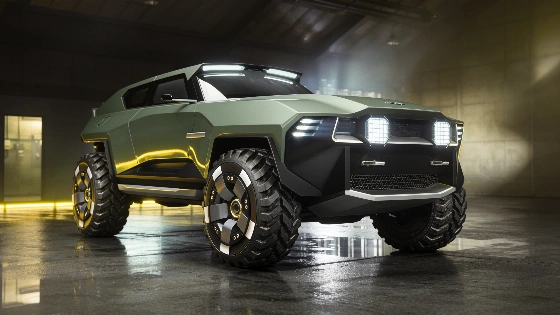
Aston Martin has stepped into the world of gaming with the Dreadnought, a digital-only SUV created exclusively for Call of Duty: Modern Warfare 4. The Aston Martin Aramco Formula One Team describes it as an “imposing creation” and presented it at the “Road to the Race” community event in Austin, Texas, alongside real-world automotive exhibits. The project links the marque’s motorsport presence with gaming as part of an effort to engage a new generation of fans.
The Dreadnought is a concept shaped for a virtual setting, not a production vehicle. Its fictional design brief pairs Aston Martin-inspired luxury with imagined performance and tactical features. The concept is described with a V12 engine and all-wheel lead; its chassis is carbon fiber, while armor and adaptive combat systems complete the design. These are elements of the digital vehicle, not published specifications for a road-going Aston Martin. The official team feature does not describe it as a production model.
The design description emphasizes the contrast between luxury detailing and its fictional combat role. Its herringbone carbon-fiber weave and Oxford Tan leather bring luxury detailing to the interior, while gold-accented controls sit against military-inspired armor and adaptive systems intended for gameplay. The concept’s visual identity, including its Chiltern Green finish, puts Aston Martin styling on an imagined vehicle unconstrained by ordinary production requirements.
The name Dreadnought evokes the British warship that helped define a class of early 20th-century battleships. Aston Martin Chief Creative Officer Marek Reichman described the project as an chance to push the boundaries of what an Aston Martin can be when imagination is the limit, calling it an “Aston Martin taken to the extreme.”
Jack O’Hara, co-studio head at Infinity Ward, has highlighted the collaboration’s scope, describing development from initial sketches through in-game physics. The concept’s four-wheel-lead layout and oversized fuel tank are presented as gameplay features for the demanding virtual environment, not specifications for a manufactured SUV.
The Dreadnought was also presented to the public at New York’s Fanatics Fest, where visitors could see a full-scale model at the Call of Duty booth. In Austin, the Aston Martin Aramco Formula One Team’s “Road to the Race” activation placed the digital creation within a broader car-culture event linked to the United States Grand Prix. The team’s feature, published October 17, 2026, and updated October 23, calls the event a gathering for car enthusiasts and frames the project as fan engagement, not a manufacturing announcement. Mercedes’ move into electric SUVs, discussed in an analysis of the GLC 400 EQ 4Matic, offers a separate example of how established automakers are seeking new ways to connect with audiences.
The Dreadnought remains a digital concept created for Call of Duty: Modern Warfare 4, not a road-going Aston Martin model. Its public display takes the project beyond the game and into branded fan engagement, while its imagined V12 power and tactical equipment remain part of the vehicle’s fictional design. The collaboration shows how gaming can give automakers space to explore brand identity and reach audiences beyond traditional motorsport and car culture.