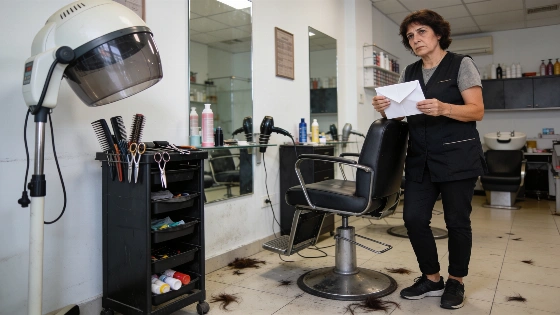
A hairdresser in Oviedo was dismissed just five days after beginning sick leave for a work-related illness. The court found the company failed to prove poor performance and raised her compensation for moral damages from €2,625 to €30,000, highlighting new legal standards for workplace discrimination.
After more than 17 years working in the same Oviedo salon, a hairdresser was dismissed just five days into a medical leave for a professionally recognized illness. The company cited a supposed drop in performance, but failed to provide evidence when challenged in court.
The Superior Court of Justice of Asturias (TSJ) has now increased her compensation for moral damages from €2,625.85 to €30,000, marking a significant shift in how Spanish courts address dismissals linked to health conditions. The ruling, TSJ AS 1616/2026, upholds the original finding that the dismissal was null and void, and orders the company to reinstate the employee and pay lost wages.
Dismissal After Medical Leave
The hairdresser had been with the salon since March 2008. In early 2025, the business changed ownership, but the new company kept the entire staff under the same conditions. There were no prior disciplinary issues on her record. Later that year, she began a temporary incapacity leave due to synovitis and tenosynovitis, both classified as occupational diseases.
Just five days after starting her leave, the company issued a disciplinary dismissal letter, alleging a sustained decline in her work performance. The letter claimed this was harming the business and terminated her contract immediately. While Spanish law allows for dismissal due to voluntary and ongoing underperformance, the employer must prove this in court. Simply being on sick leave does not automatically make a dismissal unlawful, but the burden of proof is high if discrimination is suspected.
Court Finds Discrimination
The employee challenged her dismissal, arguing it was directly linked to her health status. She also sought back pay, overtime, and €30,000 for moral damages. The Social Court No. 5 of Oviedo partially upheld her claim, declaring the dismissal null, ordering her reinstatement, and awarding lost wages. However, the court initially limited moral damages to €2,625.85.
Unconvinced, the hairdresser appealed to the TSJ, arguing the sum was insufficient to compensate for the harm and lacked deterrent effect. The higher court agreed, raising the award to the full €30,000 she had requested. The judges emphasized the employer's complete failure to justify the dismissal and noted her long service and lack of prior warnings.
Legal Standards and Broader Context
The TSJ rejected the idea that sick leave or unemployment benefits should reduce compensation for moral damages, clarifying that these payments serve different purposes. The court also referenced Spain's Law 15/2022, which explicitly protects workers from discrimination based on illness or health status, and requires full reparation when such discrimination is proven.
Another key factor was the absence of a prior hearing before the dismissal. The Supreme Court ruled in November 2024 that employers must give workers a chance to defend themselves before any disciplinary termination, in line with international labor standards. The lack of such a hearing in this case contributed to the court's decision on damages, though it was not the sole reason for nullifying the dismissal.
Recent Spanish case law has increasingly scrutinized dismissals that occur during or after medical leave, especially when employers cannot provide clear, objective reasons unrelated to health. For example, workers with insufficient employment history for standard benefits may still qualify for support, as detailed in this analysis of new unemployment subsidy rules.
Not All Sick Leave Dismissals Are Unlawful
While Law 15/2022 strengthens protections for employees on medical leave, it does not make every dismissal during sick leave automatically void. Employers can still terminate contracts if they can prove a legitimate, non-discriminatory reason. However, if there are signs of discrimination, the company must provide convincing evidence to justify its decision. Spanish law states that any dismissal motivated by prohibited discrimination or violation of fundamental rights is null and void.
Employees generally have 20 working days to challenge a dismissal, as set out in the law governing social jurisdiction. The outcome of such cases increasingly depends on the employer's ability to demonstrate a clear, lawful basis for termination, especially when health issues are involved.