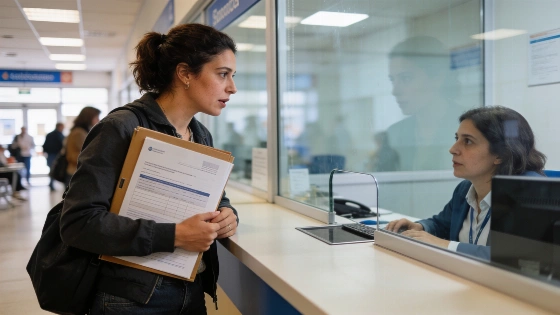
Starting in 2026, unemployed people in Spain with just 90 days of Social Security contributions can apply for a monthly subsidy of €570, even if they do not qualify for the regular unemployment benefit. The Servicio Público de Empleo Estatal (SEPE), Spain’s public employment service, has confirmed the measure and provides information on unemployment benefits and eligibility requirements. The subsidy is for workers who have not accrued enough contributions to qualify for contributory unemployment protection, which requires 360 days of contributions.
Applicants must be legally unemployed and registered as job seekers. They must also have personal income below €915.75 per month or prove they have family responsibilities. The income threshold, set at 75% of the minimum wage, reflects Spain’s recent increase in the minimum wage to €1,221 per month. Contribution history alone does not determine eligibility: applicants must also meet the relevant income and administrative conditions.
Eligibility and Conditions
Meeting the 90-day contribution minimum is only the first step. SEPE requires applicants to have no entitlement to the contributory benefit and to be in no incompatible situation. They must also sign an activity agreement and remain registered as job seekers throughout the process. Applicants can meet the income test individually or, if they have family responsibilities, by dividing total household income by the number of family members. In either case, the amount per person must not exceed €915.75 a month.
SEPE provides information on benefit requirements and handles unemployment-support applications. Applicants so need to meet the conditions for the entire period they receive the subsidy. That includes keeping their job-seeker registration active and complying with the activity agreement.
How the Subsidy Is Calculated
The amount is linked to the IPREM, the government index used to calculate social benefits, which will stand at €600 per month in 2026. For the first 180 days, recipients receive 95% of the IPREM (€570). From day 181 to day 360, the rate drops to 90% (€540), then falls to 80% (€480) after 360 days. Not all recipients will reach these later stages. Someone with exactly 90 days of contributions, for example, will receive the subsidy for only three months, provided they continue to meet the requirements.
The 90-day threshold provides access to this subsidy for people without enough contributions for the contributory benefit. It does not replace the 360-day contribution requirement for that regular benefit. The payment rate also changes over time, so the monthly amount depends on how long the recipient remains eligible.
Duration and Application Window
The maximum duration depends on the number of days contributed and the applicant’s family circumstances. Without family responsibilities, the benefit lasts from three to six months, depending on the contribution period. Applicants with family responsibilities and at least 180 days of contributions may receive the subsidy for up to 21 months.
Applications must be submitted within six months of becoming unemployed. If filed within the first 15 working days, payments start the day after unemployment begins; otherwise, they start on the application date. SEPE reviews and renews the subsidy every quarter until the maximum duration is reached.
Context and Impact
The change is expected to support workers in precarious or short-term jobs, who often fall through the cracks in Spain’s social safety net. It comes as the government seeks to adapt welfare policies to a changing labor market, where temporary contracts and intermittent employment are increasingly common. For families in remote areas, including those benefiting from fully funded school transport in Abrera, as reported in recent local initiatives, these targeted subsidies can make a tangible difference to household stability.
The strict income and administrative requirements mean that not everyone will qualify. The subsidy extends support to workers with shorter contribution records, while applicants must still pass the income test, stay registered as job seekers and comply with the activity agreement. Those rules determine who can access the payment and for how long.