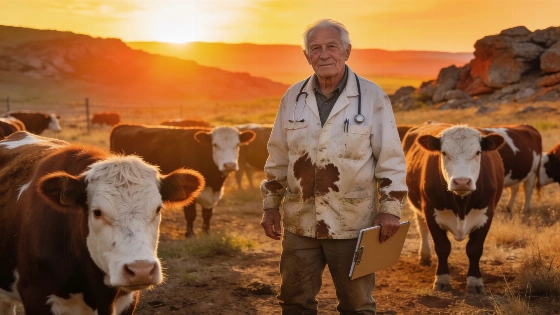
At 81, Cristian Bianchi is at work by 5 a.m., while most people are still asleep. After 59 years as a veterinarian and 37 years as technical advisor at La Gofredina, he remains a driving force in Argentina’s cattle industry. He focuses on breeding Braford cattle that thrive where others fail, showing that age is no barrier to new idea.
La Gofredina’s story began with a daunting request. Dina María Boglione, the ranch’s owner, tasked Bianchi with sourcing 600 pregnant Braford heifers in just 30 days, a challenge that would shape the ranch’s future. “That was the moment that defined everything,” Bianchi recalls. “It was like finding a diamond and learning how to cut it.”
Turning Adversity Into Chance
From that first challenge, Bianchi dedicated his career to developing cattle suited to Argentina’s toughest grazing lands, where saline soils and poor forage meet harsh climates. The resilient Braford breed became his tool for turning these environments into productive beef operations.
Success did not come from tradition alone. Bianchi championed technology by improving soils, introducing new forage species and applying reproductive biotechnology. Each step aimed to boost efficiency and adapt to the land’s limits. “By embracing technology, we changed the model,” he explains. For Bianchi, genetics is the backbone of the entire production chain, supported by nutrition and animal welfare, with smart management also impressive.
The wider Braford sector has an active breeding and sale network. At Argentina’s 2026 Nacional Primavera Braford in Margarita Belén, 26 breeding establishments presented more than 145 registered animals, information from Semana Sur’s event coverage. In a separate market report, Agrositio listed 167 Braford females at an average of US$1,710 each; 296 Brangus females in the same report averaged US$2,039. These figures show the commercial value placed on breeding stock, alongside the long-term production decisions ranches make.
Measuring Success Beyond Numbers
La Gofredina consistently achieves pregnancy and weaning rates above national averages, and calves reach higher weaning weights thanks to tailored feeding plans. But for Bianchi, true success is measured at the table. “All our work in genetics must be proven on the butcher’s block and on the consumer’s plate, whether here or anywhere in the world,” he insists.
National figures offer a broader backdrop for that ambition. Data from Argentina’s Secretariat of Agriculture, Livestock and Fisheries, summarized by Dato Puro, put 2025 beef production at 66.2 kilograms per inhabitant, within total production of 132.6 kilograms per inhabitant across beef and other meat categories, including poultry and pork. Production per inhabitant measures output divided by population. It differs from apparent consumption, so the two measures describe different parts of the food system.
To that end, La Gofredina has invested in sensory testing and systems to shorten production cycles, aiming to produce more kilos in less time without sacrificing tenderness and flavor, while maintaining overall quality. This holistic approach has made the ranch a benchmark for others facing similar challenges.
Legacy and Inspiration
After nearly sixty years in the field, Bianchi’s passion for cattle and knowledge-sharing remains undiminished. He continues to mentor producers and rural teams, guided by a simple philosophy: wake up each day with a new project in mind. His story echoes the dedication seen in other sectors, including Margarita Paradela’s commitment to traditional baking at Panadería Vilaboa, now a local institution in A Coruña (read more about her story here).
Bianchi’s journey shows how expertise and flexibility, supported by curiosity, can reshape even the most challenging landscapes. He continues to rise before dawn, setting a standard for what is possible in agriculture at any age.