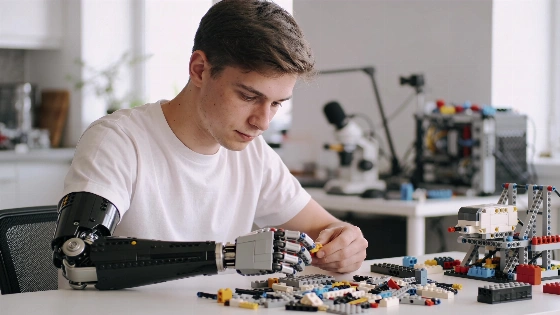
David Aguilar, born without a right forearm, built his first prosthetic arm from LEGO at age nine. Years later, his invention earned a Guinness World Record and inspired new approaches to affordable prosthetics. His story highlights the power of creativity in overcoming personal challenges.
David Aguilar was just nine years old when he assembled his first prosthetic arm using LEGO bricks. Born in Andorra with Poland syndrome, which left him without a right forearm, Aguilar faced daily challenges and frequent bullying at school. The turning point came when he realized that the same toy blocks that offered him comfort could also become the foundation for a practical solution to his own physical limitations.
Aguilar’s fascination with LEGO began at age five, when he received his first set. The blocks quickly became more than a pastime—they were a refuge from the isolation he felt among his peers. Four years later, he experimented by attaching one of his creations to his arm, discovering the potential to transform a childhood toy into a functional device. His first prototype, built from a LEGO ship set, was far from perfect: it lacked durability and full functionality, but it proved that his idea was possible and gave him a new sense of confidence.
From Prototype to Functional Arm
It would take nearly a decade for Aguilar to turn his early experiment into a fully functional prosthesis. At 18, he completed the MK-I, a prosthetic arm constructed from LEGO Technic helicopter parts. The device featured a red frame, a movable elbow joint, and a gripping claw that could be activated by flexing his upper arm. Unlike his childhood attempt, the MK-I allowed him to perform everyday tasks and even supported his weight during push-ups. This leap in functionality set the MK-I apart and marked a significant step forward in accessible prosthetic design.
In January 2017, Guinness World Records officially recognized the MK-I as the world’s first functional prosthetic arm made from LEGO. The distinction was awarded for the model Aguilar built at 18, not his initial childhood prototype—a detail that underscores the years of development and refinement behind his achievement. As Guinness World Records highlighted his story again in January 2026, coinciding with International LEGO Day, Aguilar’s journey continued to inspire as an example of ingenuity meeting necessity.
Innovation Driven by Experience
Aguilar did not stop with the MK-I. Over the years, he developed five different models, each more advanced than the last. The MK-V, for example, included five movable fingers, sensors, motors, and a pulley system, all controlled by subtle movements of his upper arm. He also shared a free video tutorial explaining how to build and program this advanced version, making his work accessible to others facing similar challenges.
His commitment to affordable solutions led him to study bioengineering and design low-cost prosthetics for others. One notable project was for Beknur, an eight-year-old boy born with underdeveloped limbs. Aguilar built two prosthetic arms for him using LEGO parts, costing just 15 euros each. One arm featured a foot-controlled claw, while the other included an electronic pointer for touchscreen devices. These designs earned two additional Guinness World Records in August 2021 and demonstrated the practical impact of Aguilar’s approach.
Expanding Impact and Social Commitment
Aguilar’s work has extended beyond personal innovation. According to the World Intellectual Property Organization, he launched the HandSolo brand, dedicating part of its profits to organizations and projects supporting people with disabilities. His efforts have become a reference point for accessibility, technical education, and workplace inclusion, showing how individual creativity can drive broader social change.
Aguilar’s story is a reminder that solutions to complex problems can emerge from unexpected places. By turning a childhood toy into a tool for independence, he not only transformed his own life but also opened new possibilities for others facing similar obstacles.