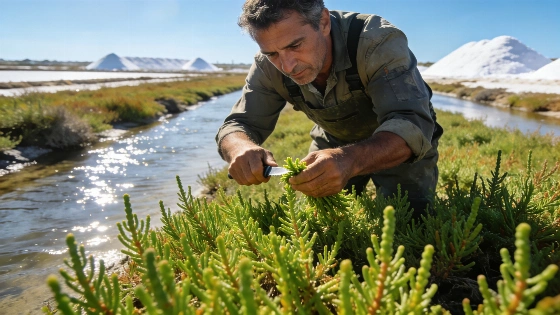
Andalusian Salicornia Recognized as a Promising Superfood for Export. Spain has launched its first industrial cultivation of salicornia—a plant capable of thriving in saline soils. The initiative has drawn interest from international institutions and pharmaceutical companies. The new product is already being hailed as a superfood.
Industrial cultivation of salicornia has begun in Andalusia—a plant previously considered a weed in the marshes of Huelva. Now it is being studied as a promising superfood, attracting interest not only from Spanish scientists but also from international research centers, including The Smithsonian Institution.
First cultivation experience
The initiative was taken by Isla Cristina resident Manuel Díaz Cárdenas, who was the first in Spain to domesticate wild salicornia. He began experimenting on the roof of his own house, later obtaining organic certification and launching a plantation of about one hectare. His company, Marsh Foods, supplies fresh salicornia on demand, and the cultivation technology has already attracted interest from other regions of the country.
Export and culinary potential
Salicornia, known as 'sea asparagus,' is in demand in the UK, France, Belgium, and the Netherlands, but is rarely used in Spain. However, the country has soils suitable for this crop. In cooking, the plant is used in salads, hot dishes, and as a salt substitute. Estimates suggest that at least 6 tons of produce can be harvested per hectare per year, and the price for one kilogram of organic salicornia can reach €35.
Scientific research and new applications
Salicornia has attracted scientists' attention due to its unique properties. Clinical studies at the Virgen Macarena Hospital in Seville have shown that the plant can be used to prevent and treat neurovascular diseases, including stroke. After drying and grinding, salicornia becomes a salt alternative for people with hypertension. The University of Malaga is studying its use as a biofilter for water purification in aquaculture, while other universities are testing its cultivation on saline and degraded soils.
Economy and risks
Manuel Díaz Cárdenas notes that increasing demand for wild salicornia could lead to the disappearance of its natural populations. Therefore, the focus is on controlled cultivation. Production is already established in Israel and Morocco, but Spanish farmers are prioritizing sustainability and quality. With proper management, five hectares can yield up to €1.5 million a year. However, the challenge of long-term storage of fresh produce remains unsolved—the shelf life does not exceed two weeks.
Reference
Salicornia contains all essential amino acids, vitamins, magnesium, calcium, potassium, as well as unsaturated fatty acids. Studies at the University of California have shown that the seeds of some species yield oil with a high content of polyunsaturated fats. In 2024, it was confirmed that consuming salicornia lowers blood pressure and levels of ‘bad’ cholesterol. The plant also has anti-inflammatory, antioxidant, and antiseptic properties, opening up prospects for use in pharmaceuticals and cosmetics.