Isabel Díaz Ayuso has filed an administrative appeal seeking to make the central government clear the Puerta del Sol protest camp, which she says is part of a left-wing effort to keep Pedro Sánchez in power. Speaking on Horizonte, the Madrid president said Spain’s democracy faces a real threat, accusing Sánchez of ignoring the separation of powers and doing whatever it takes to stay in office. Her words were blunt: “a dictator has slipped into the system.”
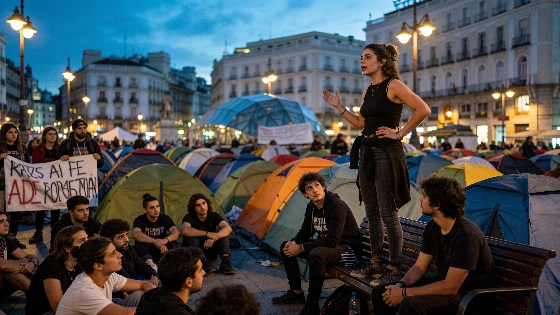
The camp in basic Madrid remains packed with protesters, most of them young and left-leaning. Demonstrators recently stopped the eviction of an elderly woman named Maricarmen and pushed the government to rush two urgent decrees through parliament. The protest has continued for at least five consecutive nights. Reuters reported that the camp has become a prominent backdrop to the parliamentary crisis over housing policy. Ayuso sees more than a protest: she claims the camp is a left-wing plan to “prepare the ground” for Sánchez to hold onto power and suggests the demonstrations are meant to keep the streets tense ahead of possible elections.
Ayuso says her appeal is about defending public order and protecting Madrid’s citizens. She warned that “decadence is a cancerous virus that spreads rapidly.” In her view, the protest is part of a deeper political game.
During the show, Ayuso learned that Junts had rejected the government’s decrees. She insisted Sánchez had always known Junts would not back the measures. “It’s all a shell game,” she said, arguing that the government wanted a public rejection to strengthen Sánchez’s narrative. Ayuso questioned how any party that supports property rights could vote for the laws and called the process political theater.
Reuters and several Spanish outlets reported that the Council of Ministers approved the two royal decrees at the center of the crisis on September 29, 2026. They were published in the BOE on September 30 and October 1. One package focuses on protecting vulnerable tenants and freezing or limiting evictions; the other introduces automatic lease extensions and stricter rules for short-term rentals.
The Horizonte broadcast grew heated. Panelists compared the Sol camp to the “mob” of the 1930s. Host Iker Jiménez made his sympathies clear. When Jiménez said he would also interview Sánchez, Okdiario’s Eduardo Inda objected, refusing to put Ayuso and the prime minister on the same level. Ayuso embraced her image as the Partido Popular’s “radical wing.” She repeated her claim that Sánchez “negotiated his term in office with ETA.” She said the left “needs revolution, wants us to kill each other, and manufactures poverty to blame the rich.”
Ayuso continued: “He is a person who feels hatred towards Spain,” she said of Sánchez. She added, “I am a tenant, I belong to the tenants’ union, though they don’t represent me much.” She painted a bleak picture: “We have entered the worst of paths. I am afraid this will not end soon. They have broken us, they want us as in 1936.”
The Sol standoff has drawn national attention. More than 1,000 protesters refuse to leave, and city officials are demanding urgent action, as Russpain reported earlier. Ayuso’s legal move raises the stakes: a housing protest has become a test of political will between Madrid’s regional government and the central executive.
Ayuso presents the protest as a threat to Spain’s democracy and casts herself as the last line of defense against what she calls creeping authoritarianism. It is unclear whether her strategy will succeed in court or sway public opinion. By escalating the conflict, she is pushing Spain’s political divide into a new phase. Sol has become a battleground over Spain’s future, and Ayuso wants to set the terms.