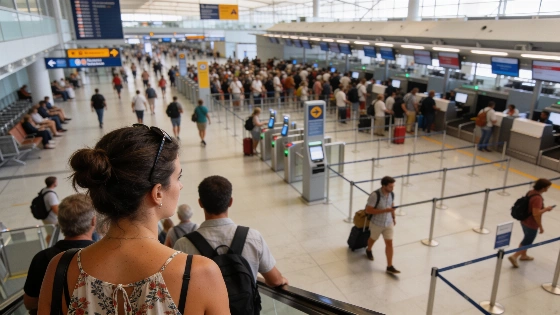
Barcelona-El Prat Airport surpassed 5.8 million passengers in July. Growth outpaces the national average, with international routes leading. The airport is set to exceed its annual capacity limit again.
Barcelona-El Prat Airport has set a new record, handling over 5.8 million passengers in July alone. This marks a 6% increase compared to the same month last year, placing the airport ahead of the average growth seen across Spain’s Aena network. The surge is not limited to the summer peak: since January, more than 34 million travelers have passed through El Prat, up 4.6% year-on-year, and already signaling that the airport will once again surpass its theoretical annual capacity of 55 million passengers by the end of 2026.
International traffic remains the main driver of this growth. Of the 5,862,148 passengers recorded in July, over 4.5 million traveled on international flights, a jump of 7.6% from July 2025. Domestic routes saw a more modest rise, with 1.3 million passengers—just 0.6% higher than last year. The airport’s management, Aena, continues to argue that expanding the Josep Tarradellas facilities is essential to strengthen Barcelona’s long-haul international connections, especially as demand for direct flights to Asia remains largely unmet.
The Barcelona Air Route Development Committee (CDRA), which includes the Generalitat, Barcelona City Council, the Chamber of Commerce, and Aena, recently highlighted improvements in connectivity with Asia. Direct flights now link Barcelona with cities such as Beijing, Shanghai, Shenzhen, Hong Kong, Singapore, and Seoul. However, CDRA studies estimate that there is still potential for more than 1.8 million additional annual passengers between Barcelona and Asian markets that currently lack direct service. The proposed expansion of El Prat, however, continues to face strong controversy due to environmental concerns, particularly regarding the impact on the Ricarda lagoon from planned runway extensions.
From January to July, 25.8 million passengers used international routes at El Prat, a 5.7% increase over the same period last year. Most of these flights connect with other European countries, underlining the airport’s challenge to attract more long-haul international traffic. Meanwhile, Adolfo Suárez Madrid-Barajas remains Spain’s busiest airport, with nearly 6.5 million passengers in July (up 6%), followed by Palma de Mallorca with 4.7 million (up 2.2%). Alicante and Valencia airports posted the highest growth rates, each at 11%.
While the debate over airport expansion and environmental impact continues, the issue of public imagery and controversy at local events remains a topic in Spain. For example, a recent incident at a Sagunto festival sparked official condemnation and renewed discussions about social responsibility at public venues.
Barcelona-El Prat’s ongoing growth highlights the city’s role as a major European air hub. The airport’s capacity challenges and the push for more direct intercontinental routes reflect broader trends in Spanish aviation. As passenger numbers continue to climb, the balance between infrastructure development and environmental protection will remain at the center of public debate. For travelers and residents alike, these changes could shape the future of air travel in Catalonia and beyond.