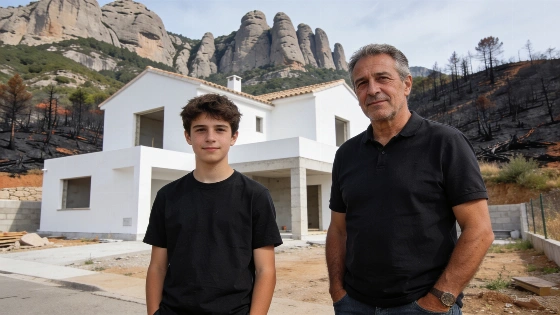
After an arson attack destroyed his home in Pont de Vilomara, Alex Codonyer spent four years rebuilding. The family faced insurance disputes, financial strain, and lasting loss. Their story highlights the growing wildfire risk in Catalonia.
In July 2022, a deliberate wildfire swept through the River Park residential area in Pont de Vilomara i Rocafort, Barcelona, leaving more than twenty homes in ruins. Among the hardest hit was the Codonyer family, who lost their house within hours as flames, driven by wind and dry conditions, engulfed the mountain community. The fire forced an immediate evacuation, with police giving residents just minutes to gather essentials and escape. For Alex Codonyer, who had recently retired after decades at Nissan’s Zona Franca plant, the disaster marked the start of a long and exhausting journey to reclaim his home and stability.
As the fire raged, Alex and his two children watched from a distance, unable to intervene. That night, a friend involved in firefighting efforts sent Alex a photo of his house fully ablaze. The destruction was total: the fire reached temperatures above 1,000 degrees Celsius, melting even concrete and steel supports. The family’s home was declared a total loss, with nothing salvageable except a single wooden table recently gifted by friends.
The aftermath brought new challenges. With no immediate funds, Alex relied on his logistical experience to navigate the complex process of demolition, temporary relocation, and reconstruction. The family spent nearly a year in Manresa before moving closer to River Park, all while construction costs soared and insurance negotiations dragged on. Every item lost had to be documented and valued, including irreplaceable sentimental possessions. The process forced Alex to sell his Barcelona apartment to cover mounting expenses.
Insurance disputes became a central struggle, with the company scrutinizing every claim. Alex described the ordeal as a daily battle, from calculating the worth of his wife’s wedding dress bought decades ago in pesetas to fighting for fair compensation on each lost object. The psychological toll was significant, but support from family, especially his brother Óscar, proved crucial. The Codonyers finally returned to their rebuilt home on December 20, 2024—886 nights after the fire.
Investigators from Agentes Rurales and Mossos d’Esquadra confirmed the fire was arson, but the perpetrator was never identified. Alex chose to focus on rebuilding rather than dwelling on resentment, though the unresolved crime remains a source of unease. He now prioritizes adapting his property to future wildfire threats, maintaining water pumps and urging local authorities to manage overgrown plots nearby.
The Codonyer family’s experience is not isolated. As wildfires become more frequent and severe in Spain, many residents face similar battles with insurance and recovery. The situation in Catalonia echoes broader concerns, as highlighted by recent reports of firefighter shortages and outdated equipment in regions like Ávila and León—issues explored in detail in coverage of the crisis facing Spain’s wildfire response teams.
Today, Alex continues to rebuild, with work still needed on his terrace and garden. He advises others affected by fire to prepare for a lengthy process, seek reliable advice, and remain persistent with insurers. The only object to survive the 2022 blaze—a wooden table—now stands as a symbol of resilience in the family’s new home, a reminder of both loss and determination in the face of Spain’s escalating wildfire risks.
Wildfires have become a growing threat across Spain, particularly in rural and mountainous regions. According to official data, the number and intensity of forest fires have increased over the past decade, driven by climate change, prolonged droughts, and land abandonment. Insurance disputes are common, as policies often contain complex clauses and exclusions. Local governments are under pressure to improve fire prevention, update emergency plans, and support affected residents. The Codonyer case illustrates the personal and systemic challenges many Spanish families now face as wildfires reshape the landscape and daily life.