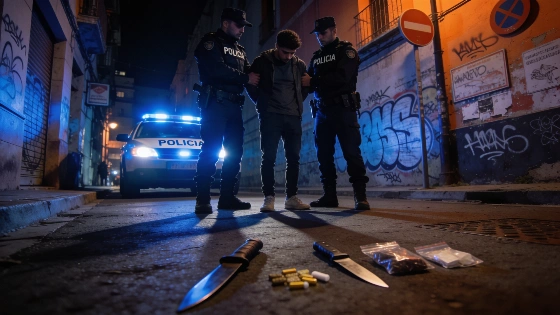
Police in Barcelona have dismantled the violent youth gang ‘los 300’. The group is accused of armed assaults, drug trafficking, and territorial control. Eighteen suspects were detained, including minors. Authorities warn of rising gang activity.
Police in Barcelona have dismantled a violent youth gang known as ‘los 300’, following a coordinated operation that led to the arrest of 18 individuals, including six minors. The group, active in Barcelona and its metropolitan area, is accused of a series of armed assaults, drug trafficking, and violent robberies. Seven adults now face prison, while two minors have been placed in juvenile centers.
According to investigators, ‘los 300’ operated with a clear hierarchy and used violence as a tool to dominate public spaces, particularly in the districts of Sant Andreu, Sant Martí, and Nou Barris. The gang’s activities included attacks with machetes and catanas, as well as the use of loaded firearms, knives, and other weapons. Police seized these items during raids in Barcelona, Montcada i Reixac, and Ripollet.
The group’s structure was organized in three levels: a leader at the top, several operational coordinators, and a base of so-called “soldiers” responsible for carrying out assaults and other criminal acts. Investigators confirmed that minors were often used to transport drugs and weapons, exploiting their lower criminal liability. The gang’s economic base relied heavily on the sale of tusi (pink cocaine) and marijuana, with some drugs reportedly prepared in members’ homes.
Authorities noted that the group’s violence was not limited to rival gangs. While many victims were young people linked to other groups, random attacks on bystanders also occurred. The gang frequently used balaclavas and other means to conceal their identities during assaults, which often resulted in serious injuries and thefts of valuables such as watches and mobile phones.
Police highlighted the role of social media in the gang’s operations. ‘los 300’ used online platforms to share violent content, display weapons, and promote their identity, aiming to recruit new members and intimidate rivals. They also produced and distributed their own music online, reinforcing group cohesion and projecting an image of power.
The dismantling of ‘los 300’ comes amid growing concern over the rise of youth gangs in Barcelona. Police estimate that between five and ten such groups are currently active in the city, often clashing over territory. The recent fatal shooting of a 15-year-old in Pegaso Park has intensified scrutiny, though police have not confirmed a direct link to gang rivalry. In a related context, the city has faced other emergencies, such as the evacuation of several buildings in the Putxet district following a major sinkhole, highlighting ongoing challenges for local authorities.
Police officials warn that the trend of organized youth violence is being fueled by social and economic factors, with some pointing to international influences. Last year alone, Mossos d’Esquadra launched three major investigations into similar groups. The authorities have pledged to maintain a firm stance against gang activity, emphasizing that violence and intimidation will not be tolerated in Barcelona’s public spaces.
Spain’s legal framework treats minors differently in criminal proceedings, which can complicate efforts to curb youth gang activity. The use of social media by such groups is a growing concern for law enforcement, as it accelerates recruitment and the spread of violent culture. The situation in Barcelona reflects a broader European trend, where urban centers are grappling with the challenges posed by organized youth crime and the need for coordinated responses from police, social services, and local governments.