Barcelona’s Bicing users report widespread issues with electric bikes, faulty brakes and unreliable app data. The city’s public bike system is under pressure as maintenance struggles and technical failures disrupt daily commutes.
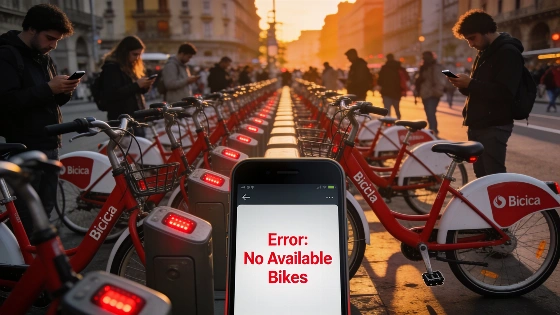
Barcelona’s Bicing public bike system is under intense scrutiny as users voice mounting frustration over malfunctioning electric bikes, unreliable app information and poor maintenance. In recent weeks, complaints have flooded social media, with subscribers describing stations packed with bikes that have dead batteries, mechanical failures, or are missing essential parts. Many say the service, once a model for urban mobility in Spain, is now struggling to meet basic expectations.
Among the most common grievances are electric bikes that appear unavailable in the app but are physically present at stations, or vice versa. Riders report finding bikes with broken chains, worn-out tires, or non-functioning brakes. Some users have even encountered bikes without pedals or with safety features disabled. The situation has become so unpredictable that regular commuters say they must leave home earlier to account for delays, undermining the reliability that once defined Bicing.
The municipal operator, Barcelona de Serveis Municipals (BSM), attributes part of the problem to recent extreme temperatures. According to BSM, heatwaves have triggered safety protocols that limit battery charging for electric bikes, which now make up 60% of the fleet and account for 80% of trips. The company says it has launched a technical and logistical plan to address the issue, including adjustments to charging systems and electronic equipment reviews. However, BSM has not responded to questions about other maintenance failures or whether user complaints have increased.
Long-term subscribers describe a sharp decline in service quality. One user, with over a decade of experience, notes that the app often displays inaccurate station data, making it difficult to plan commutes. Others mention that reporting incidents is cumbersome and rarely leads to timely solutions. Some, like Paula, rely on Bicing due to personal circumstances and have reported stations that remain inactive for days despite having available bikes. She says the lack of electric bikes and persistent brake issues have made daily use more challenging.
Mechanical problems are not the only concern. The recent redesign of the SMOU app has introduced new usability issues, with some users unable to unlock bikes with their cards or the app, depending on the station. The unpredictability has forced riders to walk longer distances to find working bikes, and many have stopped reporting problems altogether, citing the daily hassle of using the service.
Criticism extends beyond individual users. Adrià Arenas of the Bicicleta Club de Cataluña (BACC) argues that no other public transport service in the city suffers from such chronic maintenance issues. He compares the situation to a tram without doors or a metro without brakes, calling the current system “failed.”
Bicing’s operational stress is evident in its numbers: 170,000 users and a fleet of 8,000 bikes, each averaging 10 trips per day. The service, launched in 2007 and revamped in 2019 under a new contract with UTE Pedalem Barcelona, is now managed by a consortium involving CESPA-Serveo (Ferrovial) and the Canadian firm PBSC, which was later acquired by the US company Lyft. The city plans to expand the fleet to 12,000 bikes by 2029 as part of the next contract cycle.
The challenges facing Bicing echo broader issues in Barcelona’s public transport network. Recent disruptions on the Rodalies rail line, for example, have also drawn public ire, as highlighted in a report on the R3 Rodalies line suspension following a major cable theft. Both cases underscore the growing pressure on urban mobility systems to deliver reliable, well-maintained services amid rising demand and technical complexity.
Public bike-sharing schemes like Bicing are a key part of Barcelona’s sustainable transport strategy, aiming to reduce car use and improve air quality. However, the current wave of technical and operational failures threatens to erode public confidence. As the city prepares for the next phase of Bicing’s development, the effectiveness of planned upgrades and maintenance reforms will be closely watched by residents who depend on the system for daily mobility.