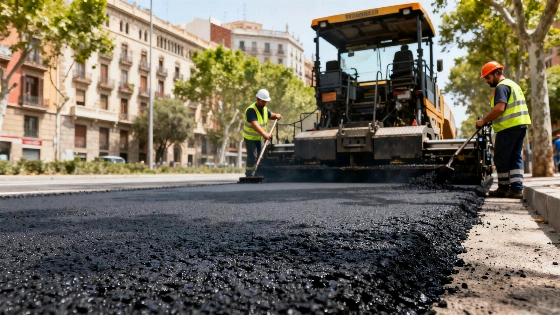
City Implements Innovative Material to Reduce CO₂ Emissions. Barcelona authorities are launching trials of a new type of asphalt infused with biochar made from olive pits and wood waste. This approach could reduce CO₂ emissions from road surfacing production by up to 75% and pave the way for more sustainable urban construction.
A unique urban experiment has started in Barcelona: part of the traditional asphalt on the city's streets is set to be replaced with an innovative material made from olive pits and wood residues. The new type of pavement, developed by a consortium including Carboliva, ELSAN, AMSA, and UPC, utilizes Biochar—a carbon-rich material produced from agricultural waste, primarily olive pits and conifer tree residues.
In traditional asphalt, key components include bitumen, mineral fillers, and limestone powder. Their production is energy-intensive and results in significant greenhouse gas emissions. The Biochar now being tested in Barcelona partially replaces the limestone filler, which, according to the developers, can reduce CO₂ emissions during asphalt production by up to 75%.
Initial laboratory tests have shown that the new material is not only more environmentally friendly but also more resistant to moisture, less prone to cracking, and better able to withstand temperature fluctuations. This is especially important for cities with heavy traffic and variable climates.
The project was selected as part of the city competition 'La sección de calle del siglo XXI', supported by the Barcelona City Council, BIT Habitat, and the Diputación de Barcelona. The winners receive funding of €90,000—enough to cover most of the costs for development, testing, and monitoring.
Until September 2026, the teams will work on refining the technology and creating prototypes. After that, pilot trials will begin on real streets in Barcelona and will last at least a year. During this period, specialists will assess the durability of the pavement, its performance under load, and the potential for scaling up to other areas of the city.
Using olive pits as a raw material for road construction is especially logical for Spain—the world's largest producer of olive oil. According to industry data, in the 2024/25 season alone the country will harvest over 1.4 million tons of olives, meaning there will be enough raw material for Biochar.
The experiment in Barcelona could serve as an example for other cities looking for ways to reduce the carbon footprint of infrastructure and implement circular economy principles. If the tests confirm the effectiveness and reliability of the new pavement, the first fully-fledged streets with this asphalt could appear as early as 2027.
As Talent24h notes, lab test results so far look promising, but much will depend on how the material performs in real urban conditions—under transport, weather, and pollution. If successful, the technology could change the approach to road construction not only in Catalonia but throughout Spain.