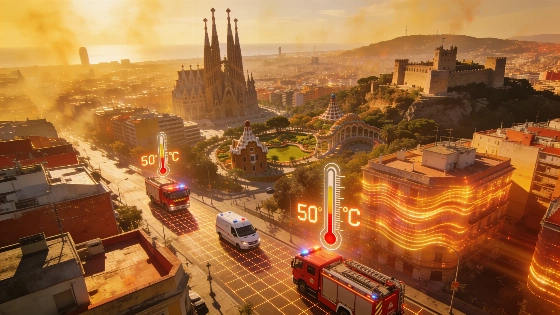
Barcelona will stage a major heatwave simulation in February. The city aims to test its resilience against unprecedented 50°C temperatures. Authorities want to prevent service collapse and protect vulnerable residents.
Barcelona is preparing for a scenario that, until recently, seemed unthinkable: a summer heatwave pushing temperatures to 50°C. City officials have announced a large-scale simulation for February, designed to test how Barcelona would cope if faced with such extreme conditions. The move comes as the region endures another intense summer, with thermometers already nearing 40°C and emergency services on high alert.
The initiative, led by Mayor Jaume Collboni, is called "Barcelona a 50º C: ensayar hoy para responder mejor mañana." It brings together key municipal departments, utility companies, and emergency services to coordinate a response plan. The goal is to identify weaknesses in the city's infrastructure and ensure that essential services—such as electricity, water, public transport, healthcare, and telecommunications—can withstand the strain of a record-breaking heatwave.
Authorities are working from the assumption that if temperatures surpass 50°C, multiple systems could be pushed to their limits at once. The simulation will test protocols for maintaining city operations and prioritizing support for the most vulnerable groups. Workshops with major stakeholders, including Aigües de Barcelona, Endesa, Naturgy, Red Eléctrica, and Transportes Metropolitanos de Barcelona (TMB), are scheduled to begin in October. These sessions will map out critical infrastructure, analyze interdependencies, and use digital models to predict cascading failures if one service falters.
After the workshops, the first phase of the simulation will take place in February 2027 as a "tabletop exercise," focusing on decision-making and coordination among city services and private partners. A second, on-the-ground drill is planned for September 2027, where the effects of an extreme heat event will be recreated to test real-time responses. Hospitals, social services, the Red Cross, and organizations like the Aliança contra la Pobresa Energètica will also participate, alongside representatives from construction, hospitality, urban cleaning, universities, and energy research sectors.
Barcelona's approach follows similar efforts in other European cities. For example, Paris conducted a comparable simulation in autumn 2023 to assess how its basic services would respond to climate-driven heat emergencies. The growing frequency and severity of heatwaves across Europe have forced cities to rethink their emergency planning. During the Tour de France, organizers were compelled to shorten stages and deploy advanced cooling measures for athletes, as detailed in this report on how French cities and events are adapting to extreme heat.
According to city officials, the upcoming simulation is not just about crisis management but also about social equity. Extreme heat disproportionately affects the elderly, those with health conditions, and residents in less protected neighborhoods. By stress-testing protocols and updating emergency plans, Barcelona aims to leave a legacy of preparedness for future generations. The city’s strategy reflects a broader recognition that climate change is no longer a distant threat but a present-day challenge requiring immediate, coordinated action.
Spain has experienced a marked increase in the frequency and intensity of heatwaves over the past decade, with 2022 and 2023 both setting new national temperature records. Urban areas like Barcelona are particularly vulnerable due to the urban heat island effect, which can raise local temperatures several degrees above surrounding regions. The city’s proactive stance may serve as a model for other European municipalities facing similar risks. As climate projections indicate that extreme weather events will become more common, the effectiveness of such simulations could prove critical in safeguarding public health and maintaining essential services during future crises.