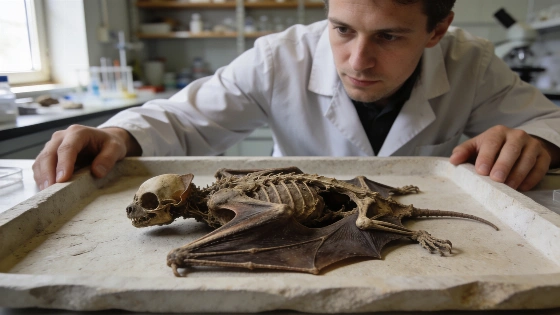
A major study places the first bats in Europe about 65 million years ago. It also suggests that powered flight and echolocation appeared almost at the start of their history.
The bat family tree has been redrawn. The first members of the group appear to have emerged in Europe about 65 million years ago. Earlier hypotheses placed their origin in Asia, Africa or the Americas. The new study also suggests that powered flight and echolocation were present almost from the beginning.
Published in Nature, the study combines 103 high-quality genomes with 44 fossils from around the world. Together, they give researchers a fuller view of bat evolution than genetic or fossil evidence could provide on its own. A UCD release distributed through EurekAlert says the dataset includes 42 new chromosome-level assemblies and representatives of all 21 recognised bat families.
Из 103 геномов, использованных в исследовании, 42 представляли новые хромосомные сборки — особенно подробный формат геномных данных для сравнительного анализа эволюции летучих мышей.
Europe was not the final destination of this lineage. It was the starting point. From the first European population, descendants spread into Africa and formed a Euro-African centre. They later reached Asia, the Americas and Australia.
The result changes more than a location on an evolutionary map.
Bats are the only mammals capable of true powered flight. Most of their more than 1,500 species use echolocation to navigate and hunt in darkness. They make up roughly one-fifth of all living mammals. They also pollinate plants, disperse seeds and consume large quantities of insects.
Статистическая модель оценила вероятность европейского происхождения первых летучих мышей в 99,2%. Это не означает абсолютной доказанности сценария: вывод зависит от совместной интерпретации геномных и палеонтологических данных.
The researchers point to the fossil genus Vielasia as an important clue. Its position on the oldest branch of the bat family tree suggests that powered flight and echolocation were already present very close to the group's origin. The two abilities that set bats apart from other mammals were not late additions. They were early foundations of the group. In its account of the work, Stony Brook University also says these traits probably appeared during the earliest stages of bat evolution.
The genetic dataset covers species from all 21 currently recognised bat families. Researchers assembled it through the international Bat1K project. The project aims to build genomic information for bat species and clarify how this exceptionally diverse group evolved. It brought together researchers from institutions including the University of St Andrews, Stony Brook University, University College Dublin and Museum für Naturkunde Berlin.
Spain was represented by the Museo Nacional de Ciencias Naturales (MNCN-CSIC) and the University of Granada. Researchers used advanced DNA sequencing and computer methods to compare the genomes. They then combined the results with fossils collected around the world.
The sample includes some of the most unusual bats alive today. It contains bumblebee bats from Thailand and Myanmar, which many consider the smallest mammals on Earth. It also includes Madagascar's sucker-footed bats and New Zealand's lesser short-tailed bat. That species uses its folded wings as front limbs when moving across the forest floor.
The breadth of the dataset gives researchers a way to compare the genetic changes behind the group's unusual variety. They are especially interested in adaptations linked to unusually long lifespans for an animal's size and resistance to certain diseases. The findings do not yet offer human treatments. They do provide a basis for studying ageing and immunity, along with disease resistance.
The study brings together two kinds of evidence that have often led to different conclusions. Genomes show how living species are related. Fossils place those relationships in time and space. Used together, they place Vielasia and other ancient bats within a firmer evolutionary structure. They also give researchers a clearer way to trace when distinctive traits appeared.
This is a major change to the story of bat evolution, not a small adjustment. Europe now occupies the opening chapter of a lineage that later spread across nearly the entire planet. The 103 genomes and 44 fossils also make the revised history a working research tool. They allow scientists to test which genetic changes produced flight, echolocation, longevity and disease resistance. The strongest result is not simply the location of the first bats. It is the evidence that their defining biology was already in place near the start of their history. The European origin finding gives future research a foundation.