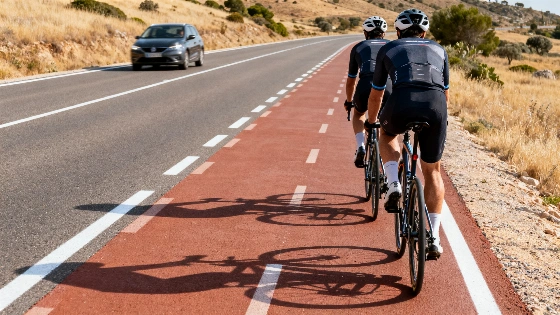
Spain Allows Construction of Bike Lanes on Highways — What Changes for Cyclists. Starting October 2025, dedicated bike lanes will appear on Spain’s national highways, even if this requires partially or completely removing the shoulder. The new rules apply to all cyclists and introduce stricter requirements for their behavior on the road.
Starting from October 10, 2025, a new road regulation comes into effect in Spain, allowing for the construction of dedicated bike lanes on sections of state highways. Now, to create such routes, it is permitted to partially or completely remove the shoulder—provided this does not compromise road safety or disrupt the functioning of the highway.
The changes apply to both individual cyclists and groups, who traditionally choose national highways for training and weekend rides. According to Spanish authorities, it is on public roads that cyclists most often encounter dangerous situations, and the new rules are intended to reduce risks and make cycling safer.
What the new regulation permits
According to the document published in the Boletín Oficial del Estado, it is now allowed to construct dedicated bike lanes on state highways, even if this requires reducing or completely removing the shoulder. The main condition is not to create a hazard for any road users. The aim is to ensure continuity and priority for cycling routes, as well as to connect existing bike networks to each other.
A complete elimination of shoulders is not planned: decisions on reduction are made individually, based on safety and the specific features of each section. Authorities emphasize that the top priority is the safety of all road users.
Rules for cyclists
The new requirements also affect the behavior of cyclists themselves. As the Dirección General de Tráfico reminds, they are required to follow the same rules as drivers and additionally adhere to a number of specific regulations:
- ride as close as possible to the right edge of the road;
- maintain a safe distance from curbs and parked cars;
- when in a group, ride no more than two abreast;
- use the right shoulder if it exists and is suitable for cycling;
- leave the shoulder only on long descents and if it is safe;
- ride in a single line in areas with poor visibility or heavy traffic.
Where permitted, cyclists may ride side by side, but only at the very edge of the road. On turns, climbs, and in areas with limited visibility, they must ride single file.
Safety and enforcement
The main reason for these changes is the high accident rate involving cyclists. According to DGT, 90% of fatalities in such accidents involve collisions with motor vehicles. In 2024, 46 cyclists died on Spanish roads, with 14 of them not wearing helmets in urban areas. Helmets are mandatory on intercity routes.
Although many of these rules were already in place, authorities are stepping up enforcement. The new regulation is aimed not only at organizing traffic, but also at reducing the number of accidents and creating safer conditions for everyone who chooses to cycle.
In recent years, interest in cycling in Spain has grown significantly, and the authorities are working to make this mode of transport not only convenient, but also as safe as possible for all road users.