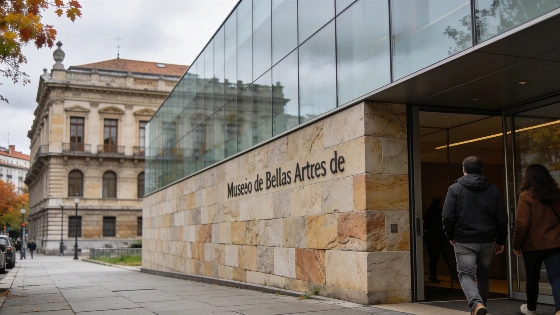
The Museo de Bellas Artes de Bilbao will reopen after more than four years of construction. Its expansion continues a story that began with a disputed plan for a serious home for modern art.
The Museo de Bellas Artes de Bilbao will open on Monday 5 October 2026. The public can enter from Tuesday 6 October, with free access continuing through 13 October. The renovated museum includes an expansion designed by Norman Foster and Bilbao architect Luis María Uriarte. It also revives a question first asked in 1908: what kind of museum should a rapidly modernising city have?
The answer was never just about storing paintings. Bilbao wanted an institution that matched its factories, banks and growing neighbourhoods. Modern art needed a permanent place there too.
The Agravitas project adds approximately 6,000 square metres and increases the museum’s total area by about 60 percent. Several reports place its budget at roughly €45–46 million.
That ambition produced two museums before the collections came together. The Museo de Bellas Artes de Bilbao opened in 1914 in three rooms at the former Hospital Civil de Atxuri. After the hospital moved to Basurto, the building became the Escuela de Artes y Oficios. Architect Ricardo Bastida adapted the neoclassical premises. Painter Manuel Losada then became director and stayed in the role for more than three decades.
The first collection came largely through deposits from the Diputación de Bizkaia, the Ayuntamiento, the Escuela de Artes y Oficios and the Santa Casa de Misericordia. Private deposits and donations increased the holdings. The opening budget reached 26,453 pesetas. Eloina Vélez's thesis Historia del museo de Bellas Artes de Bilbao: 1908-1996 describes that sum as substantial for the period.
The rooms soon became too small.
The new expansion is conceived as a bridge above the historic buildings. Rather than replacing the older structure, it connects the museum’s different stages into a single composition and supports a renewed route through the permanent collection.
Bilbao's cultural push had started earlier. Between 1900 and 1910, the city hosted six modern-art exhibitions. Artists wanted local audiences to see new work and learn the names of Paul Gauguin and Pablo Picasso. Manuel Losada was one of the strongest advocates.
In 1911, the Asociación de Artistas Vascos was created. It continued until 1937. The association organised exhibitions, built links between local and foreign artists and promoted cultural activities.
The hardest test came in 1919. That year brought the Primera Exposición Internacional de Pintura y Escultura de Bilbao. The Diputación initiated the event. It displayed works by Picasso, Cézanne, Gauguin, Van Gogh and Mary Cassatt.
Some purchases from the exhibition later entered the Museo de Arte Moderno. The event also showed that Bilbao could host European modern art instead of simply receiving cultural trends from elsewhere.
The dedicated home for contemporary art caused more dispute than the exhibitions. Critics attacked the cost. They also opposed the proposed location because they considered it too far from the centre. El Liberal called the project a "bilbainada" on 9 September 1919 and asked whether Bilbao had enough important works to justify the expense.
The plan survived.
In 1922, Lorenzo Hurtado de Saracho proposed a Museo de Arte Moderno to complement the existing institution. It opened on 25 October 1924 with 137 works. Painter Aurelio Arteta became its director. Bilbao now had one museum focused mainly on historical art and another devoted to modern and contemporary creation.
The Civil War interrupted both institutions. Their collections were evacuated to protect them from bombing. Part of the Museo de Bellas Artes holdings went to the Depósito Franco de Uribitarte. Important works from the Museo de Arte Moderno were taken to France on the initiative of the Gobierno Vasco.
After the war, one building offered the practical answer. Fernando Urrutia and Gonzalo Cárdenas designed it. The museum opened in 1945 beside Doña Casilda park and brought the two collections together. That arrangement lasted only two decades. The growing holdings and rising activity soon required more room.
A further extension was completed in 1970. Álvaro Líbano and Ricardo Beascoa designed it after visiting museums across Europe. Modern architecture and the work of Mies van der Rohe influenced the building. It became known as the museum's modern building.
In the early 1990s, the porch was closed and turned into the BBK exhibition room. The Gobierno Vasco also joined the governing bodies alongside the Ayuntamiento de Bilbao and the Diputación Foral de Bizkaia.
The next major change began after Miguel Zugaza became director in 1996. In 1998, the Consejo de Administración approved a plan to revitalise the museum and strengthen its position among Europe's cultural institutions. A competition selected architect Luis Mari Uriarte.
Another international competition followed in 2019. It produced the current renovation and expansion. The consortium linked to the project is Foster + Partners and LM Uriarte Arkitektura. The scheme is called Agravitas.
The latest work will change more than the building. EFE reports that the museum will operate every day after reopening. Standard admission will cost €12, while the reduced price will be €6. From 14 October, visitors are also due to have access to a combined ticket with the Guggenheim Museum Bilbao.
The pattern is clear.
Bilbao's museum was never a finished monument. It began with industrial wealth and artistic activism. Then came controversy, wartime evacuation, reunification and repeated enlargement. The latest project continues that pattern. Each generation expanded the museum when the city's cultural ambitions outgrew its walls.
Bilbao did not create the museum as decoration for a successful industrial city. It created the institution as part of the city's transformation. The 1908 decision set the principle. The 1919 exhibition supplied evidence. The 1924 modern-art museum gave that idea a second institutional form.
The 1945 merger created the structure that remains. The Foster and Uriarte expansion shows that the museum is still one of Bilbao's chosen tools for defining its place in the cultural world.
The expansion also gives the institution a new curatorial task. Coverage of the reopening describes a reworked route through the permanent collection, along with a substantial number of works and new inclusions. Miguel Zugaza has called the result more than an enlargement. He described it as a "new dimension" for the museum, linking the building work to the way visitors encounter the collection.