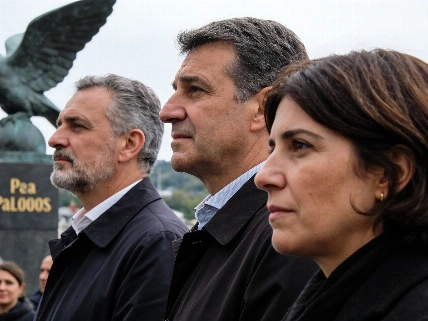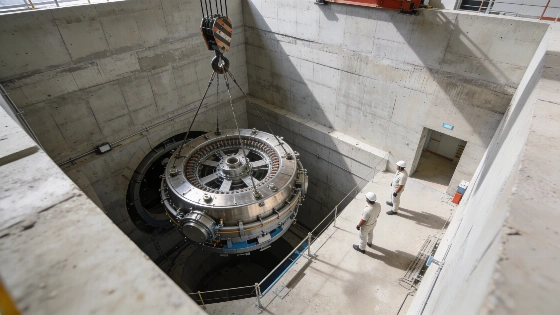
A 46-tonne cyclotron was moved into the new treatment building between Hospital Universitario Donostia and Onkologikoa on Tuesday. The machine will generate and accelerate the protons used in the unit’s cancer treatments.
The Department of Health of the Basque Government says the service is scheduled to treat its first patients in January 2027. The cyclotron’s arrival starts a new installation phase. Another major component is the gantry, a large articulated arm that directs radiation around the patient. A Basque Government Public Procurement Platform record for Osakidetza file 2026/02097, published on 5 November 2026, covers safety-and-health coordination during installation and commissioning. The contract was awarded to RCS CONSULTORIA Y SEGURIDAD S.L. and is listed as being in execution.
The overall project carries an investment of €86.3 million. That includes €28 million from Fundación Amancio Ortega, whose programme committed €280 million to buying ten cyclotrons and related installation services across several Spanish regions. The financing is separate from consumer offers such as Repsol’s fuel discounts; the Ortega funding is for proton therapy equipment and its installation. Osakidetza’s safety-coordination contract is a separate services agreement, valued at €4,420 excluding VAT (€5,348.20 including VAT), and is not financed with European Union funds.
Osakidetza is acquiring the Proteus One system, made by Belgian company IBA (Ion Beam Applications). Proton therapy can help limit radiation to healthy tissue, a particular consideration for children and for tumours close to critical organs. The source material identifies potential uses including selected brain tumours and sarcomas, as well as cancers of the eye or skull base. It does not suggest that the treatment is suitable for every cancer.
The cyclotron weighs 46 tonnes and measures 2.20 metres in diameter. Its delivery from the Port of Bilbao required a special escorted transport and a heavy-duty crane. The Consejo de Seguridad Nuclear inspected it radiologically before it was lifted, first with its protective cover and then without it.
Crews also unloaded and lifted the gantry’s counterweight. It weighs 90 tonnes and measures 10 metres in length. Its final alignment is scheduled for Thursday 12 November.
The building will have 8,287 square metres across four levels. The cyclotron and associated technical rooms are in the second basement, while the treatment room and patient preparation area are planned for the first basement. The facility will initially have one proton therapy treatment room, with space reserved for a second.
Further assembly remains, alongside calibration. The system still needs clinical checks and regulatory approval before it can enter service. Lehendakari Imanol Pradales announced the January 2027 target during the cyclotron presentation. The safety-coordination contract runs from 5 November 2026 to 5 November 2027 and covers the installation and commissioning period.