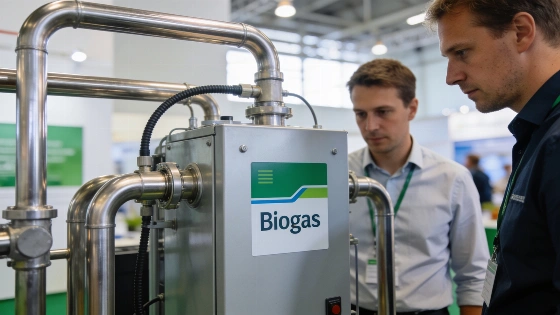
Spain's biomethane sector is moving closer to a commercial market. More than 4,230 energy professionals gathered in Valladolid to discuss investment, regulation and public trust.
On 29 and 30 September 2026, 4,230 professionals gathered in Valladolid for the sixth Salón del Gas Renovable. The talks focused on what comes after ambitious plans: clear rules, workable financing and early contact with the territories where new plants may be built.
More than 270 companies and brands showed equipment, technology and services across the renewable-gas value chain. The event, organised by the Asociación Española de la Biomasa, or Avebiom, has become a major professional meeting for biogas, biomethane and other renewable gases in the Iberian Peninsula.
In Biscay, the Provincial Council of Biscay, the Basque Energy Agency and PreZero launched Spain’s first facility to complete the full biomethane cycle on one site, from receiving and processing separately collected organic waste to producing gas ready for injection into the network.
The figures point to a market that is still at an early stage. Energética 21 reported that Spain had 23 biomethane plants in operation at the start of 2026. Their combined output was about 1.4 TWh a year.
That is a small base beside the country's estimated resource. Industry estimates cited by IndustriAmbiente put Spain's biomethane potential at around 163 TWh per year, close to current domestic natural-gas demand.
The 19º Congreso Internacional de Bioenergía turned to the decisions that could move projects forward. Grazia Vascello of the European Biogas Association called for simpler requirements and fewer regulatory differences between EU member states. She said that would help companies expand the market and trade biomethane across borders.
Sedigas and representatives of Enagás GTS also took part in discussions about biomethane and the energy transition. Their message was direct: companies need a more predictable regulatory setting before they commit to large projects.
Europe is working on one possible answer.
Daniel Maraver of the European Commission presented the Mecanismo Europeo de Biometano. Its first round is planned for autumn 2026. The mechanism is expected to connect producers with buyers, show current and future supply and demand, and explain the rules that apply in each country.
Industry estimates cited by IndustriAmbiente put Spain’s biomethane potential at around 163 TWh per year, close to the country’s current domestic natural-gas demand. The same debate includes a proposed mandatory biomethane quota, beginning at 0.5% in 2028 and rising to 6% by 2035.
That information could help developers secure gas sales before making a final investment decision. It could also help them finish financing. The first round has not yet taken place, so its practical effect is still uncertain.
Spain is also discussing a mandatory biomethane quota. The proposal would start at 0.5% in 2028 and rise to 6% by 2035.
The congress covered grid connections, guarantees of origin, production and upgrading technology, digestate, biogenic CO₂ and public acceptance. It also examined Spain's potential and lessons from other countries. Each issue affects whether a project can move beyond the planning stage.
A plant is only one part of the job.
Avebiom used the event to present 'Hablemos de Biometano'. The session brought together developers, the primary sector, administrations, neighbourhood platforms, universities and technology centres. Participants discussed how each project should fit the resources and conditions of its territory.
They also called for information and dialogue to begin early. The management and use of digestate need attention from the start of a project, not after the plant is built.
The Valladolid meeting was more than an equipment display. Technology and finance will not be enough without farmers, livestock producers, municipalities and residents. That territorial question sets this energy story apart from the sporting contest described in the promotion race: the test here is whether projects can win investment and local acceptance.
Feria de Valladolid said the previous edition drew fewer visitors. Companies at this year's event were already asking about the next one. Javier Díaz, president of Avebiom, placed less weight on attendance than on the project work, solutions and agreements pursued during the two days.
That gives the visitor count some meaning. Companies came to move business forward, not merely to display products.
The project pipeline shows why the sector is under pressure. Diario de Burgos cited industry estimates of only four or five biomethane plants under construction. Around 400 projects are planned, with roughly €4 billion in potential investment.
The gap is wide.
Spain does not lack proposals. It needs to turn them into facilities with financing, permits and local support.
Valladolid offered a clear picture of the next phase. The market needs stable and harmonised rules, a reliable route from producer to buyer and projects built around local resources. Without open planning and local participation, more trade fairs will not deliver the investment the sector is seeking.