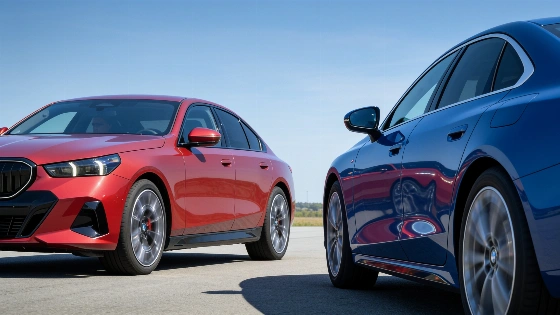
The BMW 540d xDrive has pulled ahead of the Audi A6 TDI quattro in a direct test. Both cars have close to 300 horsepower and all-wheel lead. The BMW uses a 3.0-liter inline-six mild hybrid with 303 CV and 650 Nm at just 1,500 rpm. The Audi’s 3.0 TDI V6 puts out 299 CV and 580 Nm at the same revs. On paper, the gap is small; on the road, it matters. Independent automotive databases list the BMW as a 3.0-liter mild-hybrid diesel with 303 PS and all-wheel lead, while the Audi A6 3.0 TDI quattro C9 has a 299 PS mild-hybrid V6 diesel. Recent commercial data also show that diesel versions of the Audi A6 remain available, especially in higher-end trims and on the used market, despite the shift toward hybrids and electrics.
Both cars hit 0 to 100 km/h in 5.2 seconds, but once you pass 150 km/h, the BMW pulls ahead. Its power comes on fast, and the eight-speed automatic suits the engine. The Audi’s V6 is strong and lively, but feels a bit rougher and less eager at high speeds. Both are capped at 250 km/h, though the BMW feels more at home at the limit.
The BMW 540d xDrive stands out for its fuel use. In measured tests, it used 6.4 liters per 100 km, compared with 6.8 liters for the Audi. With a light foot, those figures drop to 5.2 for the BMW and 5.4 for the Audi. For cars this big and quick, those numbers are hard to beat. For drivers who care about range, they mean freedom, not just good stats. Diesel accounted for just 10.6% of new passenger car registrations in the German market in July 2026, while hybrids and electric vehicles took a much larger share.
Inside, the differences are more subtle. The Audi A6’s cabin feels welcoming, with a mix of materials and a layout that moves past the old “Bauhaus” look. You can set up to three screens, including the Virtual Cockpit and an optional passenger display. The graphics are sharp, and the menus are easy to use. The BMW takes a cleaner approach, with its Interaction Bar and Curved Display, which blends the driver’s gauges and touchscreen. But BMW’s arc-shaped gauges, while stylish, can be hard to read at a glance.
The seats tell another story. The BMW’s optional Comfort seats are softer and offer many adjustments, making long trips easy. The Audi’s Individual Contour seats cost more but provide firmer support and great ergonomics. The rear bench in the Audi sits lower, so taller passengers have to bend their knees more than in the BMW. Both offer good rear space, but the BMW provides more knee room and a wider cabin. The trunk is another win for BMW: 520 liters versus 452 in the Audi.
On the road, the Audi A6 with air suspension and rear-wheel steering rides smoothly and steadily. The air suspension flattens out long bumps, and the rear steering makes it agile without feeling twitchy. Braking is top-notch: it takes just 30.5 meters to stop from 100 km/h with hot brakes. The BMW skips air suspension and uses adaptive Professional suspension with Integral Active Steering. The setup is firmer and gives a more direct feel, with less body roll and agility that helps hide its weight. Its braking distance is 32 meters, still strong, but the Audi stops shorter.
Weight makes a difference, too. The BMW 540d xDrive test car weighed 2001 kg, 150 kg less than the Audi. You feel this in every turn: the BMW reacts quicker and feels almost like a smaller car when pushed. The Audi stays calm and stable, while the BMW’s nimbleness is a surprise for its size.
For anyone watching how premium sedans are changing, these diesel models offer real-world range and efficiency that electric cars are still chasing. As reported earlier, electric vehicles keep pushing limits, but diesel still gives unmatched long-distance freedom without the need to worry about charging stops.
The BMW 540d xDrive wins this match with strong performance and fuel savings, along with everyday usability. The Audi A6 TDI quattro remains a strong pick, especially for those who want a softer ride and better braking. But the BMW’s bigger trunk, better fuel use and sharper handling make it the top choice for drivers who want more than a badge. These two sedans show that diesel still has a place in a market in the future.