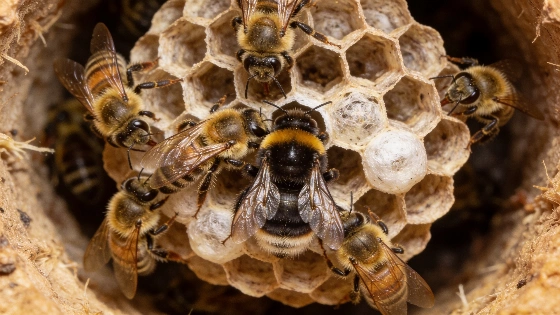
When the queen vanishes from a Bombus impatiens colony, a select group of workers steps up. New research reveals these bees become more mobile, central, and reproductively active, reshaping the colony’s entire social structure.
When the queen is removed from a Bombus impatiens colony, the result isn’t chaos. Instead, a small group of worker bees quickly steps into new roles that had been suppressed. These workers move more, take up central positions in the hive, and increase their reproductive activity, changing the colony’s social structure.
This shift is measurable, according to a study published in Communications Biology on September 3, 2026. The journal’s editorial calendar shows several studies on social signaling in bumblebee queens released during this period, reflecting ongoing research into how Bombus species regulate their societies. While some details about the authors and experiments are still being verified, the publication date and topic are confirmed by the journal’s official listings.
В августе 2026 года в Journal of Chemical Ecology была опубликована работа, подтверждающая важную роль химических сигналов маток в регуляции поведения шмелей.
In colonies with a queen, social life is tightly organized. The queen keeps worker behavior in check, suppressing differences and maintaining a clear hierarchy. When the queen is gone, the network becomes less centralized. Influence spreads among several assertive workers who fill the gap left behind.
Not every worker responds the same way. Only a few become more active and central. These workers had previously blended in, their potential hidden by the queen’s dominance. Once she is gone, their distinct traits emerge, changing both the movement patterns and reproductive roles in the colony.
The research team—Dee M. Ruttenberg, Scott W. Wolf, Andrew E. Webb, Eli S. Wyman, Michelle L. White, Diogo Melo, Ian M. Traniello, and Sarah D. Kocher—used matched partitions of the same colonies, some with queens and some without. This approach allowed them to link the changes directly to the queen’s absence, not to random differences between groups. However, as Communications Biology notes, the authorship and some experimental details still need further confirmation from official sources.
В сентябре 2026 года Communications Biology опубликовал ряд новых исследований по социальным сигналам у шмелей, что подтверждает актуальность темы динамики иерархий и химической регуляции в колониях Bombus impatiens. Независимые источники отмечают, что подобные работы способствуют лучшему пониманию гибкости социальных структур у общественных насекомых.
Bombus impatiens was chosen because its reproductive hierarchy is clear: usually, only the queen lays eggs, while workers handle maintenance and foraging. But this study shows the social order can change. When the queen is removed, the colony reorganizes, revealing a flexibility that isn’t obvious when the queen is present.
These findings are specific to Bombus impatiens, but they challenge the idea that losing a central leader always leads to disorder. In this species, the absence of a queen can create a more distributed and resilient network, though the long-term effects are still unknown. The study focused on internal social dynamics and did not address broader ecological issues or pollination efficiency.
For researchers interested in how social systems evolve, these results offer a rare look at the interaction between hierarchy and individual differences. The article is already citable with a permanent DOI, though the journal may make minor editorial changes before the final version is released.
This ability to adapt when a dominant figure is lost isn’t unique to insects. In human organizations, as reported earlier, removing a central authority can also reveal hidden talents and shift group structure. The Bombus impatiens study is a reminder that social resilience often depends on how quickly a group can reorganize from within, not just on the strength of a single leader.