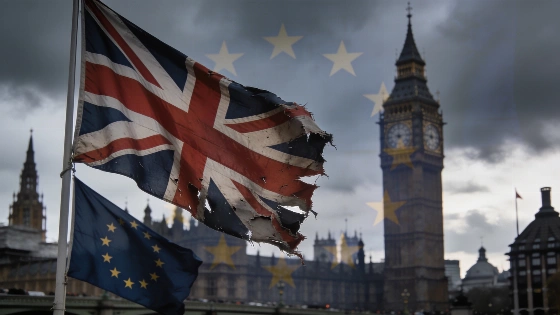
Ten years after the Brexit referendum, the United Kingdom continues to grapple with the consequences of its departure from the European Union. On 23 June 2016, 51.9% of participating voters backed leaving. Since then, prime ministers have turned over rapidly and the party system has fragmented, challenging the long-standing dominance of the basic parties. The promise to “take back control” has instead coincided with prolonged uncertainty and less influence over EU decisions.
The sequence of leadership changes began with David Cameron’s resignation after the referendum. Theresa May later stepped down after failing to secure parliamentary approval for her withdrawal agreement; Boris Johnson resigned as prime minister in 2022 amid the “partygate” crisis; Liz Truss left office after 49 days; and Rishi Sunak’s government was defeated in the 2024 general election. Brexit disputes formed part of the turbulence, alongside wider battles over fiscal policy and party strategy, as well as disputes over public services and immigration. Divisions within the Conservative Party have helped create space for challengers on the right, including Reform UK and Restore.
The 2024 result also showed how Britain’s first-past-the-post voting system can separate national vote share from parliamentary representation. Reform won five House of Commons seats with roughly one vote in seven nationally. Its rise has made it a impressive challenger to Conservative dominance, while turning protest support into a durable governing force remains a defining test for the party. Repeated leadership changes and ongoing arguments over Brexit’s consequences have left the country without a settled political direction.
The economic effects are also visible in trade with the EU. The UK formally left the bloc on 31 January 2020, and the transition period ended on 31 December that year. The Trade and Cooperation Agreement, which then governed most commercial relations, provides tariff-free trade for qualifying goods but requires customs declarations and other compliance steps that did not apply within the single market. The UK remains outside both the EU customs union and single market. The Windsor Structure, agreed in February 2023, modified implementation of the Northern Ireland Protocol and aimed to ease the movement of goods between Great Britain and Northern Ireland.
The Office for Budget Responsibility estimates that the post-Brexit trading relationship will reduce the UK’s long-run productivity by about 4% compared with a counterfactual in which the country had remained in the EU. That is a projected difference between alternative economic paths, not a claim that the economy itself contracted by 4%. The OBR identifies weaker trade intensity as the principal mechanism, including additional border costs and reduced integration with the UK’s largest nearby market. It has also assessed that newly negotiated trade agreements outside the EU are likely to have a marginal aggregate effect, partly because some largely roll over arrangements that applied through EU membership.
Goods and services have experienced different pressures. Independent analysis reports that inflation-adjusted UK goods exports to the EU in 2025 were 14% below their 2019 level, while services exports performed substantially better. The comparison with 2019 spans the pandemic and subsequent economic shocks, so it does not by itself isolate Brexit’s effect. The agreement’s tariff-free terms for qualifying goods do not remove the costs of border formalities and rules-of-origin requirements. Sanitary and phytosanitary controls, along with regulatory divergence, add further requirements. Services businesses face different barriers: restrictions on market access, recognition of professional qualifications and mobility. The UK-EU agreement provides less automatic services access than membership of the single market.
Internationally, Brexit has not prompted a comparable wave of departures from the EU. Britain retains large capabilities, including nuclear forces and a permanent seat on the UN Security Council. Its global reach also draws on a major financial centre and extensive diplomatic networks. But the UK no longer participates directly in EU lawmaking or the bloc’s collective bargaining. Accession to the Comprehensive and Progressive Agreement for Trans-Pacific Partnership has expanded the UK’s trade and diplomatic reach, though agreements further afield do not replicate the scale or proximity of the single market. The country remains impressive internationally, but its departure has reduced its formal influence over decisions made collectively in Europe.
The much-discussed “special relationship” with the United States has not, by itself, resolved the limits of Britain’s post-Brexit role. Finance and education have had to adapt to new arrangements; investment has too. Political fragmentation has also complicated the UK’s presentation as a stable partner. Britain’s European membership began in 1973, when it joined the European Communities, and ended with its formal departure from the EU in 2020. The legacy of leaders such as Margaret Thatcher, David Cameron and Boris Johnson is now viewed against a turning point that has reshaped the country’s postwar trajectory.
For Spain and other EU countries, the British experience has become a reminder of the political and economic trade-offs involved in leaving the bloc. Former EU chief Brexit negotiator Michel Barnier said that any reopening of the relationship would require a fresh decision in Britain: “It was a sovereign decision by the British people, and so any reopening of talks has to be a sovereign decision of the United Kingdom.” The debate remains bounded by the UK Labour government’s 2024 manifesto commitment to stay outside the customs union and single market, even as closer cooperation in particular sectors is discussed. Questions of political cohesion have surfaced elsewhere in Europe too, including when Catalan demands challenged the stability of the PSOE government.
Looking back across the decade, the attempt to redefine Britain’s place in the world has produced sustained debate over sovereignty, with trade and influence also at stake, rather than a settled national consensus. The UK continues to exercise large global power, but no longer does so from within the EU’s institutions. Its experience remains a complex lesson for other countries weighing national autonomy against the political and economic advantages of integration.