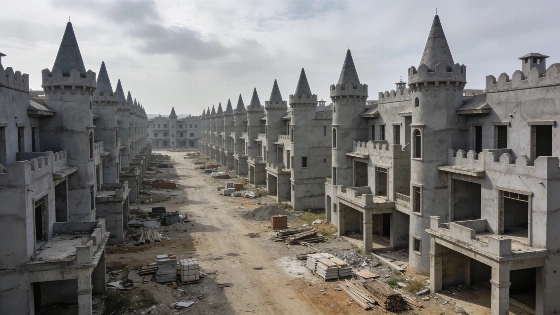
Hundreds of castle-like villas in Turkey’s Burj Al Babas remain abandoned after a failed luxury project. Authorities accuse 13 people of defrauding Gulf investors out of $67 million. The site stands as a symbol of broken promises and ongoing legal battles.
Rows of grey, turreted villas stand silent in the Turkish countryside near Mudurnu, Bolu province—a stark reminder of a luxury dream gone wrong. Burj Al Babas, once pitched as an exclusive enclave for wealthy Gulf buyers, now sits frozen in time, its 587 partially built castles never completed or handed over to their owners.
The project began with grand ambitions in 2011, aiming to construct 732 identical villas inspired by European fairy tales. By 2014, construction was underway, targeting buyers from Kuwait, Saudi Arabia, and Bahrain, with the remainder offered as timeshares for Turkish clients. Each three-story residence promised radiant heating, jacuzzis, private thermal pools, and access to a sprawling complex of shops, restaurants, and leisure facilities.
From Promise to Paralysis
Despite the glossy brochures and high prices—ranging from $370,000 to $500,000 per villa—not a single home was delivered. According to a July 2026 update from Architectural Digest, none of the structures are habitable. The development stalled in phases, with The Guardian tracing the effective halt to 2016, when contractors began to disappear from the site. By 2018, Sarot Group, the developer, had entered bankruptcy proceedings, blaming delays on harsh winters, the 2016 coup attempt, Turkey’s economic crisis, and alleged payment failures by buyers. Investor representatives, however, produced documents showing they had paid in full.
The result is a landscape of unfinished shells: 587 incomplete villas, unpaved roads, and abandoned materials, all exposed to the elements. While some facades appear finished from a distance, none meet basic living standards. The project’s scale and eerie uniformity have made it a viral sensation, with drone footage and photo essays turning Burj Al Babas into an accidental monument to failed ambition.
Legal Fallout and Accusations
The story has moved beyond viral images to the courts. Turkish prosecutors allege that 13 individuals orchestrated a $67.18 million fraud, collecting funds from 59 Gulf investors between 2014 and 2018 through over a thousand transactions. The indictment claims the developers used incomplete documentation, unregistered payments, and financial maneuvers that did not match construction progress. The accused deny wrongdoing, but prosecutors are seeking sentences of up to 885 years for each defendant, along with the seizure of assets and business interests. As of mid-2026, the trial remains unresolved.
According to Türkiye Today, a report from the Turkish TMSF fund estimates that completing the project under public supervision would require an additional $162–188 million. The same report highlights gaps in records, making it unclear exactly how much each investor paid or which villa belongs to whom. Ownership and control of the site remain murky, with conflicting reports about whether the project is now under state management or has been acquired by new investors.
Local Backlash and Lingering Questions
From the outset, Burj Al Babas faced skepticism from Mudurnu locals, who criticized the castles’ incongruity with Ottoman architecture and questioned the private use of local thermal springs. Environmental concerns and the sheer scale of the development fueled further opposition.
Unlike other abandoned developments that have found new life—such as Siete Aguas in Spain, now used for airsoft games—Burj Al Babas remains off-limits, with no official tourist access and safety risks for would-be explorers. Any future reuse hinges on resolving the legal disputes, clarifying ownership, securing funding, and addressing years of neglect.
The Road Ahead
For now, Burj Al Babas stands as a cautionary tale: 587 ghostly castles, a stalled court case, and millions of dollars in limbo. The next decisive moment will come only with a court ruling or a credible plan to revive the site. Until then, the abandoned villas remain a striking symbol of luxury promises left unfulfilled.