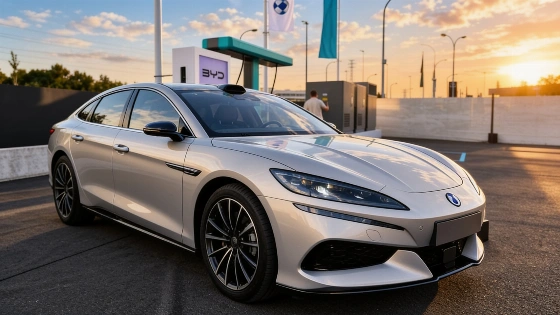
BYD has eight ultra-fast charging stations ready in Spain, but paperwork is holding them back. The company’s plan for 300 stations by 2027 now faces a real test from Spain’s slow-moving regulatory system.
Eight BYD Flash Charging stations, each rated at 1,500 kW, are sitting idle in Spain. The hardware is here. The paperwork is not. As the year ends, BYD still cannot say when these chargers will go live.
Only one pilot station is running. It’s in Leganés, Madrid. There, a Denza Z9 GT charged from 10% to 97% in less than nine minutes. That beat BYD’s own Paris demo. But the rest of the stations are stuck in limbo. Permits and approvals are tangled. Even now, it’s unclear if Leganés is one of the eight pilots or a separate case.
According to ANFAC, as of Q2 2026, 23.9% of Spain’s public EV charging points—17,821 out of 74,503—were installed but not yet operational due to regulatory delays.
This is more than a few chargers. BYD’s whole Spanish strategy is on the line. Denza announced the plan in June: 300 ultra-fast chargers in Spain, 50 in Portugal, all by the end of 2027. Any car with a CCS2 connector can use them. The price stays under 0.50 euros per kWh. Denza’s first buyers get 18 months of free charging. But eight stations is just 2.7% of the Spanish goal. To catch up, BYD would need to open about 24 new stations every month next year. That’s a steep climb.
The real problem isn’t the tech. It’s the paperwork. De Aza, a BYD executive, calls the process “quite complex.” The latest ANFAC Electromobility Barometer backs this up. By the second quarter of 2026, almost 18,000 public charging points in Spain were installed but not switched on. That’s nearly a quarter of the network. Every charger faces a maze: access permissions, city licenses, electrical checks, supply contracts. Any step can stall. Different authorities, different delays.
BYD tried to make things easier. Their stations only pull 100 kW from the grid. Big on-site batteries handle the 1,500 kW charging bursts. This setup should avoid the usual headaches—no need for special medium-voltage lines or endless talks with utilities. But even with this edge, BYD can’t promise all eight pilots will be live in three months. The bottleneck is everywhere. It’s not just a technical snag.
Regional data from the Valencian Community highlights the scale of the issue: over 2,000 charging points remain inactive there alone, with equipment installed but awaiting licenses and grid connections. This regional pattern mirrors the national challenge, as confirmed by multiple independent publications.
For now, the impact is small. Only the Denza Z9 GT can use the full power of these chargers. That car starts at 115,000 euros. Other BYD models, like the Dolphin and Sealion 7, use the first-generation Blade battery. They can’t charge at top speed, but they can still use the stations at their own limits. This will change in 2027. BYD plans to launch cars with the new Blade 2 battery, which can handle ultra-fast charging. That’s 18 months sooner than BYD first said.
But there’s a risk. If BYD starts selling Blade 2 cars in Spain while the network is stuck at a few dealership chargers, the promise of five-minute charging falls flat. The real test comes when BYD must deliver working stations on Spain’s highways, not just in showrooms. And keep prices low after the free charging ends.
The rollout has three steps. First, chargers at BYD dealerships. Next, deals with big operators and energy firms. Last, standalone stations in busy spots. The eight pilots are just the start. They show off the tech, but don’t solve travel needs. The crunch time is 2027. That’s when BYD’s network must work for real drivers on real trips.
BYD isn’t alone. As reported earlier, even established carmakers face delays and shifting schedules as they try to electrify Spain. But BYD’s plan depends on a charging revolution. Paperwork could kill the momentum.
BYD’s struggle shows a deeper problem in Spain’s EV push. Installing hardware is easy. Getting the green light to use it is the hard part. Unless Spain speeds up its rules, it could fall behind just as new electric cars hit the market. For now, BYD’s ultra-fast future is stuck in neutral. The chargers are waiting. So are the drivers.