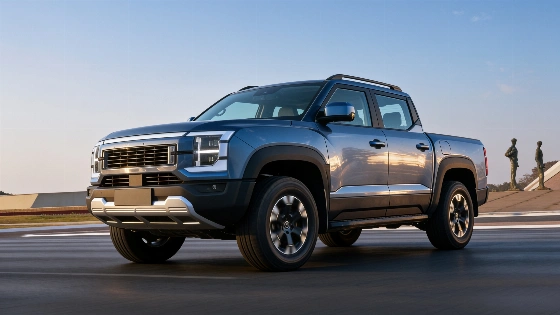
BYD has unveiled the Shark, a plug-in hybrid pickup measuring nearly 5.5 meters and producing a combined 436 PS (321 kW). The model marks a shift for the Chinese automaker, which built its reputation on electric sedans and SUVs, as it enters a European pickup market long dominated by brands such as Ford and Toyota. It is BYD’s first pickup for Europe, following its introduction in Latin American and Australian markets in 2024.
This launch takes BYD beyond exporting successful Chinese SUVs or compact cars to Europe. The company is entering the pickup market, a category with no direct predecessor in its European lineup, and expanding beyond passenger cars to challenge established players on their own turf. The rollout is planned in stages, not as an immediate continent-wide launch.
Hybrid Power, Impressive Range
The BYD Shark uses the company’s Super Hybrid DMO system, or Dual Mode Off-road, with a 1.5-liter turbocharged gasoline engine and two electric motors, one driving each axle. The motors provide electric all-wheel lead without a conventional mechanical driveshaft connecting the axles. The front motor produces 231 CV and 310 Nm of torque, while the rear produces 204 CV and 340 Nm; combined system output is 436 PS and 650 Nm. BYD says the Shark can accelerate from 0 to 100 km/h in 5.7 seconds.
The 32.2-kWh Blade lithium-iron-phosphate battery enables up to 90 kilometers of electric driving under the WLTP test cycle, while the reported combined WLTP range reaches up to 675 kilometers. The battery supports DC charging at up to 55 kW, with a 30% to 80% charge taking slightly more than 20 minutes. Using AC power, the vehicle can also be charged from 15% to 100% in about three hours.
Design and Comfort
The Shark’s design is anything but subtle. Its front end features a large grille and distinctive headlights inspired by the vehicle’s namesake, along with the largest BYD logo yet seen on one of the brand’s models. The double-cab body seats five, and its cabin has amenities more typical of a family SUV than a work truck.
The Shark measures 5.475 meters long, 1.971 meters wide and 1.925 meters high. It is built on a ladder-frame platform, with independent double-wishbone suspension on both axles. Reported work-use specifications include a payload of 790 kg, a towing capacity of 2,500 kg and a cargo-bed volume of approximately 1,200 liters. Those figures position it as both a family vehicle and a working pickup.
Strategic Shift for BYD
Stella Li, BYD’s vice president, emphasized the significance of the launch: “We are delighted to bring BYD’s plug-in hybrid technology to the pickup segment with the SHARK. This vehicle benefits from our DMO technology, offering electric driving capability, class-leading power, excellent off-road performance, outstanding efficiency, and great versatility for long journeys.”
The Shark was first introduced in Mexico in 2024, and its European debut opens a new chapter for BYD. The company, now recognized as the world’s leading electric vehicle producer, aims to broaden its appeal and compete in segments where electrification is still emerging. In Europe, the initial UK introduction is expected to be followed by Germany in early 2027, with further markets planned during the first half of the year. Italian coverage puts its arrival there in the first quarter of 2027 and reports an indicative starting price of about €54,000 excluding VAT. National pricing and specifications will depend on each market’s launch.
The Shark has also received a five-star safety rating from Euro NCAP, an independent assessment that strengthens its pitch to European buyers. The move reflects broader industry trends. The upcoming Mazda MX-5 NE, for example, is expected to be the last gasoline-powered Miata as manufacturers adapt their lineups to meet new emissions standards and changing consumer expectations. Mazda’s transition shows how even iconic models are developing in response to electrification.
Facing Established Rivals
BYD’s entry into the European pickup market will put it up against well-established models such as the Ford Ranger and Toyota Hilux, both with loyal followings and proven track records. The company is betting that the Shark’s electric range and hybrid efficiency, paired with its high performance, will attract buyers seeking something new in a segment traditionally dominated by established manufacturers.
As the Shark prepares to arrive in Europe, its success will depend on how quickly consumers embrace plug-in hybrid pickups and whether BYD can deliver on its promise to combine utility with long-distance capability and technology.