More than eight in 10 people surveyed by Cáritas Castilla y León reported financial difficulty linked to housing costs. The study found 53.7% had sought outside help with residential expenses, while one in three needed help with rent.
A third of respondents had needed help with at least one monthly rent payment. The finding points to a central problem in the Cáritas Castilla y León study: getting a home does not guarantee that a household can afford to keep it.
More than eight in 10 people surveyed reported financial difficulty linked to housing costs. Some 53.7% had turned to at least one source of support to cover residential expenses. The study, «Habitar entre la precariedad y la exclusión. Un análisis de la situación de la vivienda de las personas atendidas por Cáritas en Castilla y León», was presented in Burgos after two years of work. It draws on a 30-question survey prepared by FOESSA.
Rental access is also restricted by conditions applicants may be unable to meet. Insufficient income affected 42.1% of respondents. A lack of an employment contract or payslip affected 35%. Difficulties linked to foreign origin affected 28.9%.
Regional figures offer a wider picture of housing costs and economic hardship. EAPN España’s XVI report, based on the INE’s 2025 Encuesta de Condiciones de Vida and published in October 2026, put the number of people living in poverty in Castilla y León at 475,000, or 19.8% of the population, 32,000 more than a year earlier. A further 24.1%, about 578,000 people, were at risk of poverty or social exclusion. Among people renting at market rates, 53.3% were at risk of poverty or exclusion and 48.7% lived in poverty.
The same INE data showed that housing costs exceeded 40% of income for 7.6% of the region’s population and for 32.7% of people already living in poverty. Some 8.8% of residents reported delays in rent or mortgage payments, while 11.2% could not keep their homes at an adequate temperature in winter.
Young people face particular barriers to living independently. In 2025, only 11.4% of 16-to-29-year-olds in Castilla y León lived independently, down 2.2 percentage points from the previous year. The average rent reached €744 a month, a 9.4% annual increase. Renting a home alone would have taken an average of 68.3% of a young person’s net monthly salary, rising to 93.9% for those aged 16 to 24. The Consejo de la Juventud de España’s Observatorio de Emancipación Juvenil also reported that 28.8% of young people in the region were at risk of poverty or social exclusion; the region had the fourth-lowest youth emancipation rate among Spain’s autonomous communities.
The results define residential exclusion more broadly than having no home. It can mean being unable to access housing or afford its costs without sacrificing other basic needs. Some people rely on outside support to stay housed. Lack of independence and housing conditions that affect health and wellbeing are also part of the picture.
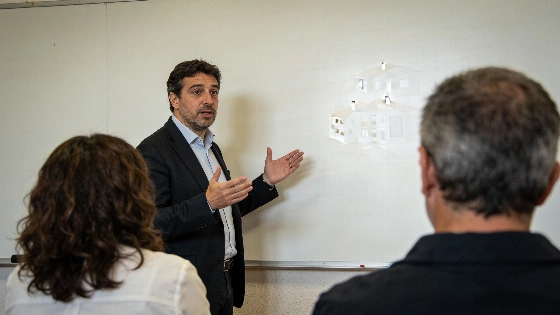
The study was presented at the XXIV Regional Days of Cáritas Castilla y León, where more than 200 volunteers and technical staff gathered in Burgos over two days. The event’s theme was «Construyendo comunidad desde el derecho a un hogar». Sara Galindo of ZIES Investigación y Consultoría and María Gutiérrez, Cáritas Burgos’ social action coordinator, presented the findings.
Enrique Cabero, president of the Economic and Social Council of Castilla y León, focused his keynote on Article 47 of the Spanish Constitution. He described housing as a constitutional right that people must be able to exercise in practice. He warned that the absence of that right could put people at risk of poverty and exclusion. Taking all the variables of residential exclusion into account, he said it could affect 53% of the region’s population.
Cabero called for housing to be treated as an inherent right rather than only as a market good. He also urged action on housing to prevent exclusion. Building consensus, he argued, is necessary to address poverty and exclusion.
The question of finding a suitable place to live also touches residential care: a Barcelona project has introduced AI tools to help families search for care homes and handle calls staff cannot answer, as reported in this care-home project.
The two-day meeting included a Monday Eucharist presided over by Archbishop Mario Iceta, followed by a visit to Burgos Cathedral. On Tuesday, Raúl Flores, FOESSA’s technical secretary, and Luis Miguel Rojo, a Burgos native and episcopal delegate of Cáritas Española, discussed Cáritas’ position on housing. The gathering closed with a shared position: housing underpins health and autonomy, while shaping relationships and life plans.