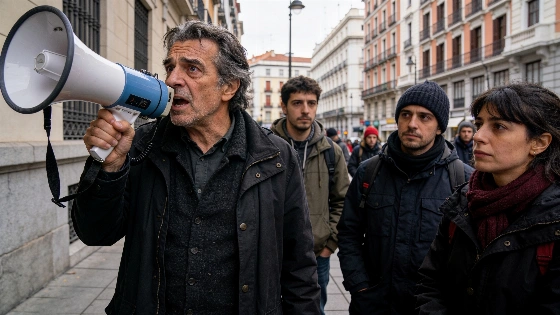
At an eviction protest on Sainz de Baranda in Madrid, Carlos Bardem meant to defend Maricarmen Abascal. Instead, he called out, "Paquita, you are not alone." The crowd heard the wrong name. Bardem corrected himself, but the moment had already shifted, and the mistake quickly spread online as a snapshot of the awkward gap between Spain’s privileged left and the causes its members claim to support.
Paquita was there that day, but she was not the one at risk of losing her home. Bardem quickly added Maricarmen’s name, along with others. The story spread on social media, and doubts about celebrity activism grew louder. BBC and The Guardian reported that the protest was part of a broader effort to stop the eviction of 87-year-old Maricarmen in Madrid’s Retiro district. Hundreds showed up; El País and ElDiario reported that around 10,000 people joined, prompting authorities to block streets around the site. It was the fourth attempt to evict Maricarmen, and activists had previously prevented enforcement. The Guardian and BBC reported that supporters had spent nights outside the building to block authorities from carrying out the eviction. Tensions rose: police used tear gas, and clashes broke out in the street.
The phrase izquierda caviar comes from French slang and describes people who talk about equality but live in comfort. Bardem’s slip wasn’t the first of its kind. Emma Thompson, for example, joined Extinction Rebellion protests in London in 2019 and called for urgent action on climate change. She had just flown in from Los Angeles, about 5,400 miles away. Her team said she had work in the US. The contradiction was clear: that same day, activists targeted Heathrow Airport.
Thompson later said she was disappointed not to be arrested at the protest. It was her 60th birthday. British media focused on her flight’s carbon footprint instead of her message. When celebrities step up as moral voices, their own choices can trip them up.
Other stars have faced even harsher backlash. In November 2023, Susan Sarandon spoke at a pro-Palestinian rally in New York. She said Jewish Americans who felt fear were getting "a taste" of what it meant to be Muslim in the US. The reaction was swift: her agency, UTA, dropped her. Sarandon apologized, calling her words "a terrible mistake." She said she wanted to highlight rising intolerance and did not intend to downplay Jewish suffering.
The Bardem family has seen this before. In 2014, Javier Bardem and Penélope Cruz signed a manifesto against Israel’s offensive in Gaza, alongside Pedro Almodóvar and others. They called it "genocide" and "state terrorism." The backlash, especially in the US, was immediate. Cruz and Bardem later clarified their statements, distancing themselves from accusations of antisemitism and saying they wanted peace for both Israelis and Palestinians.
Even climate activism gets tangled. Javier Bardem was a leading voice at Madrid’s 2019 Climate March, where he demanded urgent action. But he often traveled between Europe and the US, including trips to film festivals, leaving a big carbon footprint. Reports have said that he and Cruz sometimes used a private jet to reach Madrid, making their green image harder to defend.
The more celebrities tie themselves to causes, the more people scrutinize their every move. The risk extends beyond embarrassment: the message itself can disappear. Public protests in Spain often become tests of authenticity, with high-profile names drawing as much doubt as support.
The Bardem episode is a warning: activism filtered through fame and privilege can lose its bite. The cause may be right, but the messenger matters. When the messenger stumbles, the message gets lost. For Spain’s cultural elite, real commitment takes more than a slogan or a photo op; it takes humility and discipline. Otherwise, advocacy turns into performance, and the public tunes out.