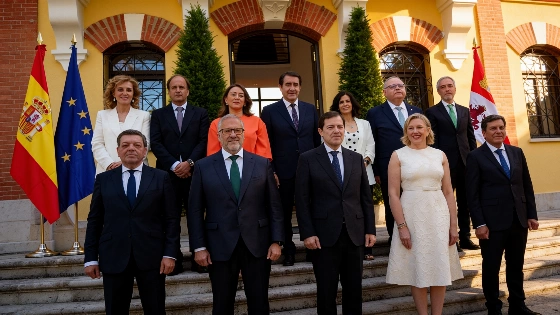
Asset declarations from Castilla y León’s top officials reveal sharp differences in personal wealth. From five homes and luxury cars to heavy debts, the disclosures show what the region’s leaders really own.
Cristina Sanchidrián, the minister in charge of Mobility, Digital Transformation, and Artificial Intelligence, stands out among her peers. She owns five homes, three high-end cars, and owes the bank more than €350,000. These are her official numbers, not those of a real estate tycoon. The Junta’s twelve members have just published their asset declarations in the Boletín Oficial de Castilla y León. EFE and Europa Press report that Sanchidrián’s properties are worth almost €773,220. She holds five properties in Ávila and Madrid, some shared 50% with others.
Sanchidrián leads in real estate, but the rest of the cabinet is not far behind. President Alfonso Fernández Mañueco owns two homes in Salamanca and a rural property in Segovia. Most ministers have at least two homes each, spread across Valladolid, Madrid, Burgos, and León. Only a few—Luis Miguel González Gago, Juan Carlos Suárez-Quiñones, María González Corral, and Alberto Díaz Pico—list just one home. Suárez-Quiñones, though, also owns a third of sixteen rural plots in León. According to ElDiario.es, the twelve cabinet members together control 24 homes, both in cities and the countryside.
The official publication of asset declarations for the twelve government members took place on September 18, 2026, as mandated by Article 21.1 of Ley 3/2016.
The pattern changes with vehicles. Three ministers—María González Corral, María Pardo, and Joaquín Antonio Pino—report no cars at all. Carlos Fernández Carriedo, who handles Economy and Finance, tops the list with three cars: two Audis and a VW T-ROC bought this year. The president drives a used BMW and an Audi Q3. Health minister Alejandro Vázquez owns a Citroen C3 and a Renault Austral. The oldest cars in the cabinet, a Volvo S-60 Berlina and a Mercedes Clase A, have been on the road for over twenty years. They belong to González Gago and Suárez-Quiñones. Only one motorcycle shows up in the government’s fleet—a Suzuki Burgman from 1999, owned by Carlos Pollán. ABC reports that the government as a whole declares 13 cars and 1 motorcycle, with several vehicles more than two decades old.
The ministers’ bank accounts together hold just over €1.08 million. But their debts are even higher. Nine out of twelve officials owe a total of €1.2 million in loans and credits. Sanchidrián again leads with €350,000 in debt. Fernández Mañueco follows with nearly €194,000, González Corral with €154,000, and Pino with over €164,000. On the other side, Isabel Blanco, González Gago, and Fernández Carriedo have no loans or credits. ABC and Heraldodiariodesoria confirm that the cabinet’s total debt is higher than their cash savings.
Looking at liquid assets, Alejandro Vázquez has the most in his bank accounts—over €407,000. González Gago is close behind with nearly €500,000, according to EFE, and Isabel Blanco has more than €144,000. At the bottom, Pino and González Corral have less than €10,000 each. Investment portfolios show more gaps. Sanchidrián holds almost €1 million in financial products. Fernández Mañueco and Pino each have over €140,000 in funds and plans. Others, like Isabel Blanco and Suárez-Quiñones, have smaller amounts in pension plans and shares.
The legal basis for publishing these asset declarations is Ley 3/2016, which requires all high-ranking officials in Castilla y León to disclose their assets in the Boletín Oficial and on the Gobierno Abierto portal. This transparency measure is part of a broader trend across Spain to increase accountability among public officials.
These declarations, required by law and posted on the regional government’s transparency portal, give a rare look at the personal finances of Castilla y León’s political leaders. The numbers show not just wealth, but also the heavy debts many officials carry. In most cases, debts are bigger than their liquid assets. This level of transparency is now common across Spain, as more regions push for public accountability. Recent regional reporting shows how property and car ownership trends connect to wider economic and social changes.
The figures paint a picture of a government where personal wealth varies a lot. Some officials have several homes, expensive cars, and big investments. Others have less, but many carry large debts. These declarations remind us that political power in Castilla y León often comes with complicated personal finances. Transparency is a tool for public scrutiny, but whether it leads to more trust or just exposes the gap between leaders and the public remains to be seen.