Fernando Grande-Marlaska says migrants left Ceuta voluntarily or under judicial or administrative decisions. More than 400 protection applicants withdrew their claims, and over 500 expulsions were carried out.
About 80,000 people crossed from Morocco into the Spanish enclave on July 30 and 31. At least 140 migrants died, in what the Associated Press described as the deadliest crisis on the border. Figures reported on Tuesday put the number still in Ceuta at 10,000 or more. Temporary reception centres have 7,477 places. The autonomous city’s protection system has registered 3,019 minors.
Estimates of how many migrants remain have differed. Spain’s Interior Ministry put the figure at about 10,000 in September, while Ceuta Mayor Juan Jesús Vivas said it could reach 15,000. Against that backdrop, Interior Minister Fernando Grande-Marlaska says 12,000 departures from Ceuta were lawful. On October 16, he said the first phase of the emergency operation had concluded. At a news conference in Ceuta, he said those who left for Morocco did so voluntarily or following judicial or administrative decisions. The figure covers departures recorded since August, not a single operation.
Some migrants have told media outlets, including EL PAÍS, that Spanish officers said their departure to Morocco had already been decided. Those accounts surfaced as exits accelerated after police cleared informal settlements. Camps on the beaches of Benítez and El Trampolín were among the sites cleared, and as many as 1,000 people returned in little more than a day. Marlaska rejected allegations of covert collective expulsions.
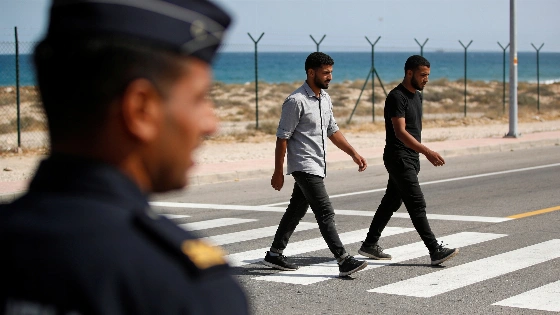
He said officers from the Policía Nacional and Guardia Civil acted under national and international law. Images showing officers guiding migrants across the border by the arm, he explained, involved people who had freely withdrawn their applications for international protection. Those withdrawals were documented in formal statements, with lawyers present.
More than 400 protection applicants gave up their claims before their administrative cases were completed. The 12,000 departures also include more than 500 expulsions, Marlaska said. He described the other departures as voluntary returns or as the result of individual decisions. Those decisions could be judicial or administrative.
Several thousand migrants remain outside the temporary centres, including in outlying neighbourhoods and on hillsides. The government’s next phase includes reinforcing police deployments and looking for people who left the cleared sites. Officers will check for the use of another person’s documents or false papers. Operations are also planned on the coasts of Málaga and Cádiz to prevent irregular arrivals to mainland Spain. The crisis has left people in makeshift camps on beaches. Others are living near warehouses or on hillsides.
The authorities also plan to speed up return cases and protection requests. The Interior Ministry says it has doubled resources and can process an average of about 100 cases a day. These include asylum applications, though most are return procedures. New modules are expected to let officials handle up to 100 cases each day.
Ceuta, governed by Juan Jesús Vivas of the PP, is responsible for caring for unaccompanied migrant minors. Spanish law requires each case to be considered individually; it does not permit the automatic return of all children. The central government has helped provide temporary accommodation and funds for each child’s legal representative. It has also approved more than €90 million in aid for Ceuta.
Local authorities say they lack enough resources to house and protect the children. Marlaska said the government was ready to assess them, while minors were arriving only in small numbers. Vivas has called for a way to return minors to Morocco, citing pressure on the city’s system. Youth Minister Sira Rego said most minors in Ceuta wanted to stay in Spain and would be allowed to do so.
During his visit, Marlaska inspected police facilities at El Tarajal with government delegate David de la Encina. The trip came three days after Felipe VI and Queen Letizia visited Ceuta on October 13; their public reception was covered in an earlier report. Felipe VI described the late-July crossing as a violation of Spain’s border and voiced support for Ceuta’s sovereignty and territorial integrity. He also called for migrants, including minors living in difficult conditions in makeshift camps, to be treated with respect.