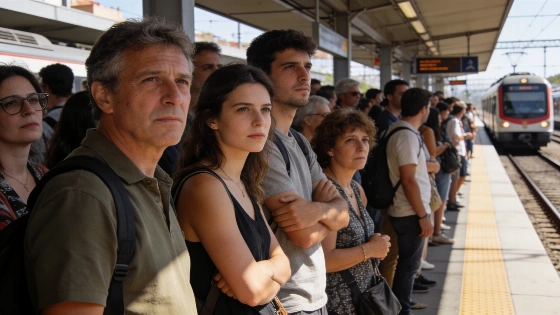
Transport in Catalonia collapsed during the eclipse as Renfe trains failed to handle the surge. Officials now acknowledge planning errors and communication gaps. Emergency measures were needed to restore order.
Transport authorities in Catalonia have acknowledged serious shortcomings in their preparations after Renfe's Rodalies train network was overwhelmed by crowds during the recent solar eclipse. The secretary of Mobility for the Generalitat, Manel Nadal, admitted that both the planning and execution of the special transport operation fell short, leading to severe congestion and confusion at key stations between Barcelona and Tarragona.
Nadal explained that while the number of trains was doubled for the event, the actual flow of passengers did not match forecasts. The main issue arose in the afternoon, when thousands of travelers converged on Barcelona Sants station, hoping to reach Tarragona for the astronomical event. Contrary to expectations of a staggered departure, most passengers arrived within a narrow time window, causing bottlenecks and overcrowding. The return journey, according to Nadal, was more orderly thanks to the intervention of the Mossos d'Esquadra, who managed station access and coordinated departures as trains became available.
Images from the day showed packed platforms and tense scenes as travelers struggled to board. The situation escalated to the point where Civil Protection activated a pre-alert for the Ferrocat plan, and police were forced to restrict access to platforms at stations such as Tortosa, Tarragona, and Altafulla to prevent safety risks. Renfe, for its part, denied any lack of foresight, stating that all available trains were deployed and that no passengers were ultimately left behind, as an additional 'sweeper' train was sent late at night to collect remaining travelers.
Nadal conceded that communication with the public was insufficient, particularly regarding the need for staggered departures and the availability of return trains. He also acknowledged that conditions on board were far from ideal, with reports of overcrowding and inadequate air conditioning. While the Generalitat later described the overall operation as a success, official statements omitted mention of the railway collapse, focusing instead on the absence of major incidents and the scale of the mobilization.
Notably, the original security and mobility plans presented in July did not address the specific challenges of rail transport for the eclipse, despite coordination efforts between Rodalies and the Generalitat in the weeks leading up to the event. The reinforcement measures included additional trains and longer convoys, but these proved insufficient for the actual demand. As highlighted in coverage of the eclipse preparations, authorities anticipated a massive influx of visitors, but the scale and timing of passenger movements outpaced their projections.
The incident underscores the challenges of managing large-scale public events in Catalonia's transport system. Rodalies, operated by Renfe, is a critical link for regional mobility but has faced repeated criticism over reliability and capacity. The eclipse episode has renewed calls for improved contingency planning, better real-time communication with passengers, and greater investment in infrastructure to handle extraordinary demand. For many residents and visitors, the experience highlighted both the popularity of public transport and its current limitations during peak events.
Spain's regional rail networks, especially in densely populated corridors like Barcelona-Tarragona, are vital for daily commuting and special occasions alike. While the Generalitat and Renfe have pledged to review their protocols, the episode may prompt broader discussions about funding, modernization, and the need for flexible emergency responses in the face of unpredictable surges. The lessons from this eclipse could shape future strategies for managing transport during major public gatherings across the region.