

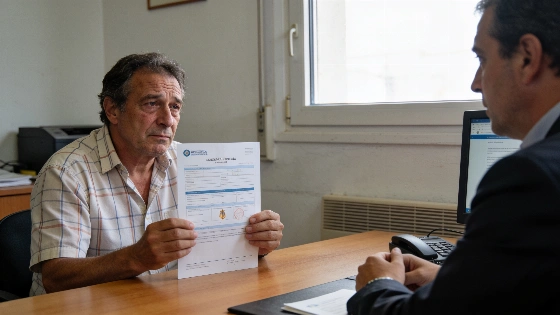
A Barcelona factory supervisor will receive more than 90,000 euros in backdated disability payments after the INSS lost its appeal for failing to pay during the legal process. The court’s decision highlights the strict rules on provisional pension payments in Spain.
The Tribunal Superior de Justicia de Cataluña dismissed the INSS’s appeal not because of a medical dispute, but because the agency failed to pay the worker’s pension during the appeal process—a legal requirement. As a result, the worker is now owed more than 90,000 euros in overdue benefits.
The case involves a 49-year-old supervisor from a vehicle manufacturing plant in Barcelona. Since 2023, he has been seeking recognition of permanent absolute disability. His medical history is complex: Crohn’s disease, severe psoriasis, psoriatic arthritis, chronic migraines, tenosynovitis in both hands, and moderate depression. Despite ongoing treatments, his symptoms made regular work impossible. Court documents describe daily life with frequent urgent bowel movements, constant joint pain, and persistent inflammation.
The Catalan court identified the case as STSJ CAT 5465/2026, a reference now used in legal databases to track similar rulings.
After the Catalan medical board gave its opinion in September 2023, the INSS rejected his claim the next month and dismissed his administrative appeal. The worker then went to the Social Court in Barcelona, which ruled in his favor in December 2025. The judgment recognized a 100 percent disability pension based on a regulatory base of 3,389.10 euros per month, with payments retroactive to September 2023. However, the INSS did not start paying the pension during its appeal, as required by law. Instead, it submitted a certificate stating payment began in December 2025. A second certificate from March 2026, issued by the INSS, confirmed that no payment had actually been made.
Spanish law requires the managing entity to pay the pension provisionally during the appeal process. If it does not, the appeal can be dismissed without reviewing the medical evidence. That is what happened here. The court found no proof of payment and rejected the INSS’s appeal, confirming the lower court’s decision and leaving the agency with no further arguments on the medical facts.
The back pay—90,675.80 euros—was calculated by Tribunal Médico, the legal office representing the worker, based on the months the pension was not paid. This amount may be adjusted for annual revaluations, legal caps, or any incompatible earnings, but the main point remains: the INSS’s failure to follow procedure led directly to a significant financial penalty.
Recent legal analyses confirm that in 2026, the Catalan court has repeatedly dismissed INSS appeals in social security cases due to procedural violations, not just medical disagreements. This reflects a broader trend in Catalonia, where courts emphasize strict adherence to process in disability and benefit disputes.
The maximum public pension in Spain for 2026 is set at 3,359.60 euros per month, so the worker’s recognized base does not guarantee he will receive the full 3,389.10 euros monthly. The final amount will depend on statutory limits and any other income. Each disability case is judged individually, and this ruling does not automatically set a precedent for others with similar illnesses.
The court’s June 2026 resolution is not yet final, as a further cassation appeal to the Supreme Court is possible within ten days. Still, the legal options for the INSS are now limited, and the worker’s right to payment appears secure according to Tribunal Médico’s August update. For others navigating Spain’s disability system, the case shows how important it is to follow procedure—something also seen in recent rulings from other regions.
What stands out here is not only the severity of the worker’s health problems, but the INSS’s failure to meet its legal obligations. The agency’s attempt to delay payment led to a costly defeat and a clear message: Spanish courts expect agencies to follow the rules in social security cases. When they do not, the consequences are significant.



