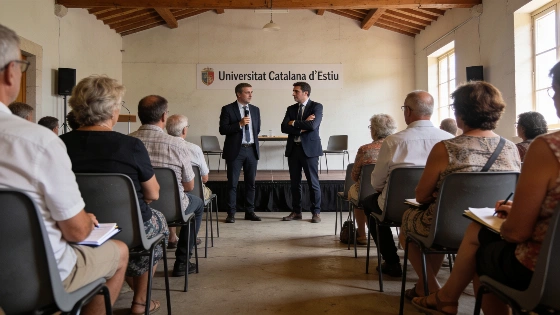
The Universitat Catalana d’Estiu closed its 58th edition amid sharp criticism of the Catalan government. Organizers cite delayed subsidies and a sense of neglect. The future of the event remains uncertain.
The 58th edition of the Universitat Catalana d’Estiu (UCE) ended with organizers openly criticizing the Catalan government for delayed subsidies and what they describe as unprecedented neglect. The annual event, held in Prada, France, since 1968, brings together leading figures from Catalan politics and culture for a week of conferences and debates focused on the Catalan language and identity.
This year, uncertainty over funding cast a shadow over the event’s organization. According to the UCE Foundation’s president, Joan Domènec Ros, the university has never before felt so poorly treated by the Generalitat, regardless of which party was in power. The criticism was delivered directly to Francesc Xavier Vila, the Generalitat’s Language Policy Minister, who attended the closing ceremony.
Organizers revealed that, as late as mid-July, they were still unsure whether the Generalitat’s Department of Research and Universities would confirm its financial contribution for 2026. Additionally, 20% of the previous year’s budget remained unpaid, and the regional government of Occitanie had cut its support by more than half. These setbacks raised doubts about the event’s continuity and forced last-minute adjustments.
In response, Minister Vila attributed the subsidy delays to administrative issues and insisted that the government’s support for the UCE remains firm. He emphasized the university’s role as a vital meeting point for academic and cultural exchange, especially at a time when, in his words, the academic world faces confusion from unscientific dogmas. Vila also noted that the UCE’s cross-border nature—operating between France and Spain—makes it a unique space for reflection and dialogue.
Amid the funding controversy, the president of the Lleida Provincial Council, Joan Talarn, announced that his administration would double its financial support for the UCE. The closing ceremony also saw the announcement of the Premis Canigó 2026, awarded to La Bressola and the newspaper El Punt Avui.
Financial pressures on cultural and educational institutions in Catalonia have become a recurring theme in recent years. For example, ongoing debates about public funding and resource allocation have also affected other sectors, as seen in the region’s social services. A recent analysis highlighted by russpain.com pointed to similar challenges in maintaining adequate support for essential services. The situation at the UCE reflects broader tensions over how cultural and academic projects are prioritized within Catalonia’s budget, especially when cross-border or minority language initiatives are involved. The future of the Universitat Catalana d’Estiu now depends on whether promised support materializes and if the event can adapt to shifting political and financial realities.