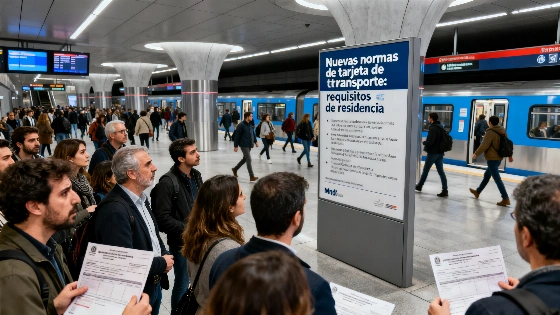
Catalonia has refused Madrid's proposal for shared funding of public transport cards. The new residency rule affects 200,000 people. Galicia demands reciprocity, while other regions weigh their response.
Catalonia has formally rejected Madrid's proposal for a nationwide co-financing agreement on public transport cards, intensifying the debate over new residency requirements in the capital. The Generalitat argues that Madrid's plan, which would require other regions to help fund access for their residents, would only deepen fragmentation in Spain's transport system and fail to address underlying issues.
The dispute centers on a rule introduced in June that obliges users to be registered residents in Madrid to obtain or renew a transport card, with limited exceptions. This change, affecting around 200,000 people, has drawn criticism from several autonomous communities. Catalonia's government, led by Salvador Illa, maintains that the place of registration should not determine access to public transport discounts, especially in a country where daily mobility often crosses regional boundaries for work, study, or family reasons.
Galicia has also voiced concerns, with regional president Alfonso Rueda calling for strict reciprocity if any agreement is reached. He insists that if Galicia is to co-finance Madrid's system for Galician students, Madrid should do the same for Madrid residents using Galician transport. Other regions, including Ceuta, Canary Islands, Valencia, Cantabria, Castilla y León, and Extremadura, have shown interest in negotiating similar deals, while Castilla-La Mancha already has an arrangement in place.
Madrid's authorities, seeking to mitigate the impact of the new rule, sent letters to regional counterparts in June, inviting them to sign agreements based on "cooperation and financial responsibility." The aim is to allow young people from other provinces to continue benefiting from transport discounts without the need to register in Madrid. However, the process is expected to take months, as each region weighs the legal, economic, and operational details.
Some regions remain undecided. The Basque Country has yet to make a decision, while Aragón has requested more information. The Balearic Islands are studying the proposal, and Andalusia has not responded. The new rule is enforced strictly: since June 15, only those registered in Madrid—or with specific exceptions such as large families or residents of certain municipalities in Castilla-La Mancha and Castilla y León—can obtain or renew a transport card.
The financial implications are significant. Agreements with Castilla-La Mancha and Castilla y León have already led to millions in joint spending, with costs calculated based on actual journeys made. Madrid's move to activate a 2011 regulation after 15 years is attributed to technological upgrades, the pandemic, and shifting demand, but its timing—less than a year before the 2027 municipal and regional elections—has raised questions, especially as Vox pushes for "national priority" policies in coalition talks with the Partido Popular.
For many, the new residency requirement creates practical hurdles. Foreign students and migrants are among those most affected, particularly given the backlog in Madrid's registration system and the challenges faced by those living in sublet arrangements. The alternative—online registration—is not widely known, and some rental contracts restrict who can be officially registered at an address.
This regional standoff over transport policy comes as Spain's political landscape remains volatile. Recent developments in party leadership and coalition negotiations, such as the changes within Sumar following Yolanda Díaz's departure, reflect broader tensions over regional autonomy and national policy direction. For more on the shifting dynamics in Spanish politics, see the analysis of Sumar's leadership transition at Madrid Congress ushers in new Sumar direction.
Spain's public transport systems are managed at both regional and municipal levels, with funding and fare structures varying widely. The current dispute highlights the complexities of interregional mobility in a country where economic, educational, and social ties often cross administrative borders. As negotiations continue, the outcome will shape not only access to discounted travel but also the broader debate over how Spain balances regional interests with national cohesion.