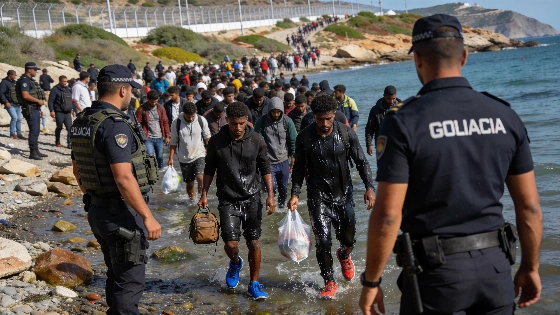
Over 60,000 migrants crossed into Ceuta in days, overwhelming local resources. Authorities blame Morocco’s lack of border control. At least 57 people have died during the crossing.
Ceuta has experienced an extraordinary influx of migrants, with more than 60,000 people crossing from Morocco in just a few days. The situation escalated rapidly after Spain’s Supreme Court ruled against immediate returns for those entering without passing physical barriers, a decision that quickly spread among Moroccan youth via social media. This legal change, combined with Morocco’s initial tolerance of crossings, led to a surge that local authorities describe as unprecedented.
Security sources indicate that Moroccan authorities were aware of the growing movement toward the border but allowed the first waves to pass, possibly as a demonstration of influence over migration flows. However, the scale of the response caught Rabat off guard. Within 24 hours, government figures estimate that around 50,000 people reached Spanish territory, while Ceuta’s own count reached 60,000. By late yesterday, 48,300 had reportedly returned to Morocco, but at least 57 migrants lost their lives attempting the crossing.
The response from both Spain and Morocco was slow to adapt to the crisis. Spanish officials mobilized 106 additional personnel to support the Guardia Civil and 200 more for the National Police, but both forces reported that reinforcements arrived too late to prevent chaos. The Unified Association of Civil Guards (AUGC) and the Justice for the Civil Guard (Jucil) highlighted the lack of resources and called for Ceuta to be declared a zone of special singularity, demanding more staff and infrastructure, including an extension of the El Tarajal breakwater.
Moroccan internal issues, such as corruption and poverty, further complicated the situation. Security sources suggest that the Gendarmerie often turns a blind eye unless given direct orders, and the authorities’ passive approach contributed to the mass entry. Analysts believe Morocco’s objectives may include testing Spain’s and the EU’s reactions and leveraging migration as a tool in diplomatic relations, especially after Spain’s shift away from neutrality on Western Sahara.
While some officials in Madrid have publicly thanked Morocco for its cooperation, others argue that a firmer stance is needed. Blaming criminal networks for the surge is seen as misplaced, as most migrants organized themselves through social media and crossed independently, rather than relying on traffickers. The crisis has exposed Spain’s limited capacity to manage such large-scale arrivals, echoing concerns raised during previous incidents. As noted in a related report, Ceuta’s infrastructure has struggled to cope with sudden mass arrivals in the past.
Ceuta, a Spanish enclave of just 18 square kilometers, has long been a focal point for migration from North Africa. The city’s proximity to Morocco and its role as a gateway to Europe make it particularly vulnerable to sudden shifts in migration policy or enforcement. The events of recent days highlight the ongoing challenges at Spain’s southern border and the complex interplay between legal rulings, international relations, and local realities. The deaths and humanitarian strain underscore the urgent need for coordinated action and sustainable solutions.