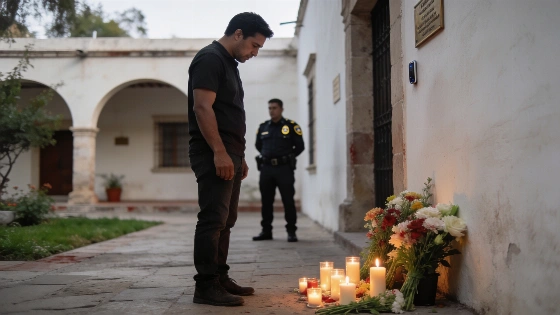
Valentín Tacoronte visited the Cuautla site where his daughter was killed. The man accused of the murder is now in custody and faces a feminicide charge.
Valentín Tacoronte stood silently at Cuautla’s Casa de la Cultura after collecting his daughter’s body from the Morelos prosecutor’s office. He came to the site one day after authorities arrested Francisco Javier, known as El Trompas. Prosecutors accuse him of killing Claudia Tacoronte, a 21-year-old Spanish student whose death has intensified anger at the Universidad Autónoma del Estado de Morelos, or UAEM.
Flowers and candles marked the place where Claudia was stabbed on 12 September. Spain’s consul in Mexico, Marcos Rodríguez, accompanied her father. Officials from Morelos were also there. The group stayed for several minutes before the family continued the repatriation process.
The University of Granada cancelled the arrival of three additional students for internships or exchanges in Morelos after Claudia Tacoronte’s killing.
The arrest has moved the case into the judicial phase.
Federal and state authorities detained El Trompas in Cuautla after executing an arrest warrant. Mexico’s federal security secretary, Omar García Harfuch, said federal and state forces took part in the coordinated operation. The suspect was taken to the Centro Estatal de Reinserción Social, or Cereso, de Cuautla, on Thursday night. He remains under judicial authority, and his first hearing before a judge has not yet taken place.
The Fiscalía de Morelos plans to charge him with feminicide and seek the maximum sentence of 70 years in prison. That is the prosecution’s request, not a court ruling. The suspect remains accused as the judicial process begins.
Reporting on the case said Mexico’s National Intelligence Center was also brought into the investigation, underlining the high priority assigned to the murder. The involvement does not determine the suspect’s guilt, which remains for the courts to establish.
Claudia arrived in Mexico in mid-August for an academic exchange between the Universidad de Granada and UAEM. She was from the Canary Islands and was 21 years old. Morelos prosecutor Fernando Blumenkron described the identification procedure carried out before her body was formally handed over to her father.
The case has also exposed the scale of concern at UAEM. Claudia was the fourth university student killed in seven months, after Kimberly Ramos, Karol Toledo and Michelle Itzayana Fuentes. Reports on violence at the university have also cited the killing of Aylin Rodríguez Fernández. The deaths had already led to student protests and work stoppages. UAEM said it felt “deep indignation” and called for an immediate, thorough investigation from a gender perspective.
UAEM said it was keeping in contact with Claudia’s family through the University of Granada and Spanish consular channels. Spain’s foreign minister, José Manuel Albares, said Spain wanted to get to the bottom of what happened. The Spanish consul’s presence during the visit to the crime scene and the repatriation process showed how that coordination was being handled.
Cuautla lies 120 kilometres south of Mexico City, but the case now reaches far beyond the city. It concerns the repatriation of a Spanish student, the detention of an alleged killer and a university community that had already protested other deaths. The next concrete step is the first hearing. Prosecutors are expected to present the feminicide accusation, and the suspect will appear before a judge.
Claudia Tacoronte’s death cannot be treated as an isolated criminal case. A 21-year-old exchange student was killed at a cultural venue. She became the fourth UAEM student murdered in seven months. The arrest is a procedural step, not a judicial finding. The case now depends on whether prosecutors can sustain the accusation in court and whether responsibility is established through the legal process.