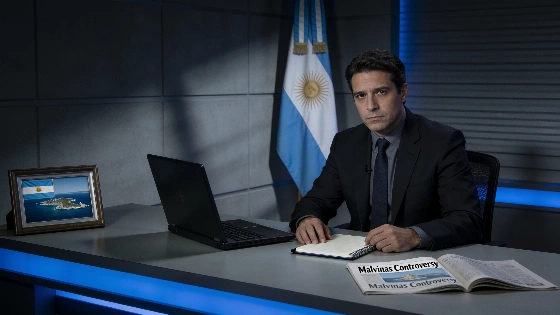
Claudio Savoia, political editor of Clarín and a regular TN panelist, has come under fire for a controversial statement about the number of Argentine military personnel killed in the Malvinas War. His reported comparison of the 649 Argentine deaths with figures from a world war was widely criticized as insensitive and uninformed, particularly by people connected to the fallen soldiers and others across Argentina. The figures refer to different conflicts and cannot be meaningfully compared without defining the population and time frame, or clarifying which deaths are counted.
The remarks, made during a recent broadcast, drew attention because of Savoia’s prominent role at Clarín, one of the country’s leading newspapers. Observers said his comments appeared to minimize the losses suffered during the Malvinas conflict, a deeply sensitive subject in Argentina. The war lasted 74 days, from Argentina’s seizure of the islands in April 1982 to the Argentine surrender. Argentina recorded 649 military deaths. The conflict also killed 255 British military personnel. Three Falkland Island civilians died as well. Many of the approximately 23,000 Argentines deployed to the islands and the South Atlantic theater were conscripts aged 18 or 19.
Other media figures also challenged Savoia’s perspective. Commentator Sehikman offered a different interpretation, suggesting that Savoia’s approach failed to grasp the gravity of the issue. The incident has reignited debate about the responsibilities of public figures and journalists when addressing matters of national importance and historical trauma.
The controversy comes as discussions of Argentina’s recent history and its impact on national identity remain highly relevant. Argentina’s military junta, led by Leopoldo Galtieri, launched the operation to seize the islands. British Prime Minister Margaret Thatcher’s government then dispatched a task force. The war’s legacy remains intertwined with the deaths of hundreds of young conscripts. It is also bound up with Argentina’s transition away from military rule. The Argentine Constitution describes recovery of the islands as a “permanent and inalienable objective.” The sensitivity surrounding the issue is reflected in the country’s memorial practices, just as national pride and remembrance intersect in coverage of major events such as the high-stakes World Cup semifinal between Spain and France.
The national death toll has also been the subject of debate over which wartime deaths are counted. In a 2026 report, Junín councilor and South Atlantic conflict veteran Flavio Bojko objected to a museum display listing 632 deaths rather than 649, saying the lower figure excluded 17 personnel who died on Argentina’s continental territory during wartime actions. The dispute illustrates why casualty comparisons require clear definitions of the people and deaths included.
The Argentine Cemetery at Darwin remains a basic memorial site. It holds the remains of 249 Argentine combatants, while a cenotaph bears the names of the 649 Argentines killed in the conflict. Built in 1983 under British authority, the cemetery was renovated between 2001 and 2004 with support from the families’ association and businessman Eduardo Eurnekian. Argentina declared the site a National Historic Place in 2008. For families and veterans, its role in remembrance reflects how the war’s losses continue to shape public discourse and why language about them can provoke strong reactions.