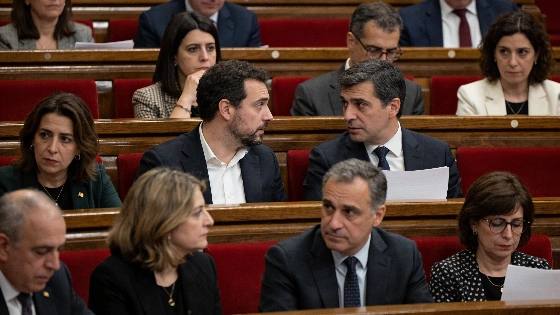
Spain’s Congress has voted down the government’s proposed lobby law. The measure failed after PP, Vox, and Junts opposed it, stopping plans for a mandatory register of interest groups.
The government’s plan to regulate lobbying in Spain fell apart in Congress after PP, Vox, and Junts joined forces to vote against the proposed law. With their combined votes, the measure was defeated, and the idea of a mandatory register for interest groups was shelved, despite last-minute efforts to save it.
The decree, which would have created a public and compulsory register for all lobbying groups, had already been approved by the Council of Ministers on August 25, 2026, published in the BOE on August 26, and entered into force on August 27. Congress later overturned it. According to figures from RTVE and Newtral, 155 deputies voted in favor, 179 against, and 12 abstained. PP, Vox, Junts, and UPN opposed the law, while PSOE, Sumar, ERC, and Bildu supported it.
By the time of the vote, around 300 organizations had already registered in the new lobby register, but the legal basis for this registry was lost after the decree was rejected.
Sumar’s stance shifted in the final hours. The party had threatened to vote against the law over disagreements with PSOE about whether unions should be included in the transparency rules. In the end, Sumar backed the government, though its deputy spokesperson Aina Vidal had already cast a remote 'No' vote. This confusion did not change the outcome, as the right-wing bloc’s majority left the law with no chance of passing.
Business groups also opposed the law. The CEOE, Spain’s main employers’ association, objected because the decree would have required them to register and disclose information before meeting with public officials. Unions UGT and CC.OO. called for the law to be withdrawn and resubmitted as a full legislative project, not a decree, to allow for more debate in Congress. According to Demócrata, the government tried to reassure critics by clarifying that constitutionally protected social dialogue with unions and CEOE would remain outside the scope of the decree.
Minister Óscar López, responsible for Digital Transformation and Public Function, promised a future amendment to make clear that social dialogue would not be affected. He also urged PP to be consistent, pointing out that the party supports similar transparency measures in Europe and has negotiated them with Brussels and sector representatives. López said that 90% of parliamentary amendments had already been included in the text.
The failure of the lobby law has raised concerns about Spain’s ability to meet its commitments under the EU’s Recovery and Resilience Facility, with several media outlets noting that up to 1.5 billion euros in European funding could be at risk if transparency reforms are not implemented.
The Objective
Professional lobbyists and institutional relations experts had urged Congress to approve the decree, saying it addressed many of their longstanding demands for transparency. But opposition from business, unions, and key political parties proved too strong.
The failed law highlights the ongoing difficulty of passing transparency reforms in Spain’s divided parliament. It follows other recent legislative setbacks, where shifting alliances and last-minute changes have blocked government initiatives. As seen in previous coverage, political deadlock and divided interests continue to shape the legislative process.
Spain is left without a national framework for regulating lobbying, despite pressure from Brussels and calls for more openness. The government’s failure to win support from both its left-wing partners and the opposition shows how hard it is to pass reforms that affect powerful interest groups. Until a new agreement is reached, the status quo remains and the push for transparency in political decision-making is once again stalled.