As the parliamentary session resumes and deputies and support staff return to the lower house, the Congress of Deputies has rolled out new uniforms for its ushers. It turned to Peris Costumes, a Madrid-based firm known for its work in cinema and television. The three-year contract, valued at €892,956, covers 2,498 items for ushers and support staff in maintenance and medical roles, along with regular dry-cleaning services.
Peris Costumes is based in Algete, south of Madrid, and has worked on film and television productions including Gladiator II and La sociedad de la nieve. The assignment covers uniform components, including jackets and trousers, with buttons and ties also specified. The design remains unchanged from previous years, but production calls for detailed craftsmanship: a team of 31 makes most items in-house, while specialist pieces such as tie pins go to subcontractors. Some garments take about half an hour to make; others require several hours.
Peris Costumes has also worked with public institutions, including the INAEM, Spain’s National Institute of Performing Arts and Music. Uniforms for official bodies often require details that standard textile manufacturers do not typically provide. The Congress contract was awarded through a public tender, and the company considers it a relatively small project compared with work for larger entertainment-industry clients.
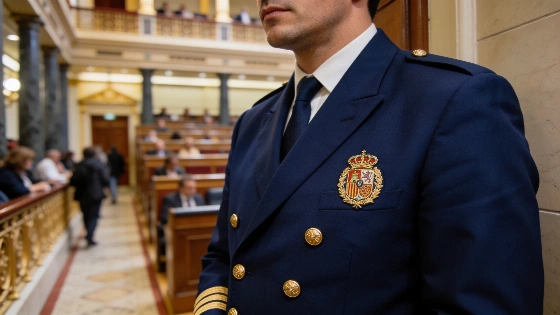
The tradition of uniformed ushers in the Spanish Parliament dates back more than 150 years. The 1851 Internal Government Regulations established the requirement, specifying gold-trimmed jackets and blue trousers. They also called for tricorn hats. Today’s uniforms, adapted for men and women, feature navy jackets with gold buttons and the constitutional crest. Matching waistcoats complete the outfit, while white shirts pair with blue trousers edged in gold. An optional skirt is pleated at the front and decorated with four gold buttons and the crest. For formal occasions, including high-profile visits, ushers wear a ceremonial version with additional detailing. The jackets are short or long, depending on the season.
Uniform maintenance follows detailed requirements. Under the 1854 Regulations, staff must keep uniforms in good condition for three years and may wear them only while performing official duties. Lockers inside the Congress building provide storage. Uniforms are collected every two weeks for cleaning; medical staff uniforms are collected daily. The contract also provides for nearly 7,000 ironing services a year and two garment bags per worker for handling and identification. The uniforms are made in the same workshops used for film productions, but stored and cleaned separately.
Spain’s growing profile as a film and television production hub has drawn greater attention to companies such as Peris Costumes. The sector is expanding in other regions too, including Alicante, where international productions have generated impressive economic activity. A recent Disney project in Alicante was credited with boosting the local economy by more than €40 million, illustrating the audiovisual industry’s wider impact on Spain’s economy and employment. The Congress contract brings that creative-sector expertise into a parliamentary setting, linking a longstanding institutional tradition with the work of a Spanish costume company active in international production.